
Her på Blåvand's blog bringes korte nyheder i dagbogsformat om livet og hændelser på fuglestationen.
-
FORSIDE

- Blog
Se indlæg fra måned: mar. (31)apr. (30)maj (31)juni (16)juli (18)aug. (32)sept. (30)okt. (13)
DMI, you bastard!!
mandag 31. august 2026
Observations:
Ringing:
Looking at the radar this morning, it was clear that we would not be able to reach standard due to a large lurking raincloud that was due to pass over us at around 9. Before that, however, it looked as if we would have a couple of hours free from rain to catch birds in, just after a small initial rain-cloud passed us over. Working from this prognosis, we set out to open nets as soon as the first rain had stopped, but just after opening, we got a first-hand demonstration of the limitations of the predictive powers of the radar; the small initial rain-cloud was growing, giving rise to additional brief but heavy showers, and we were forced to run out to close the nets almost immediately again.
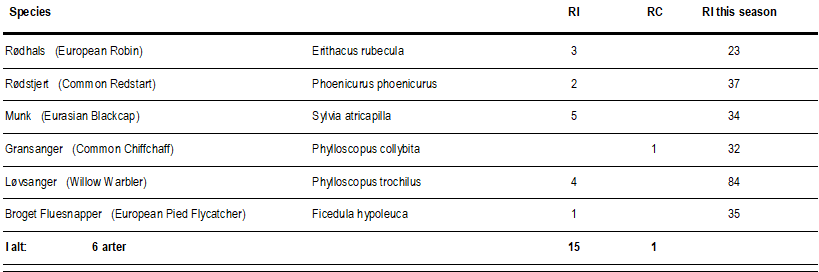
Deciding not to risk the weather any more this morning, we went back inside to relax while it rained for most of the morning/midday. At around 3 in the afternoon, the weather looked to have cleared up for good for the day, and we opened up the Station garden for some afternoon/evening ringing, which Johan joined in on. Although it wasn't much, we did get some nice birds, with a total of 16 birds caught, most of whom were Eurasian Blackcaps (Sylvia atricapilla).
Today's total captures:
At the station: Johan, Strummer, Alba
Oh DMI, you rascal!
søndag 30. august 2026
Observations:
Today started out like other days lately. With a shit forecast. The dutiful volunteer I am, I managed to get into obs position in spite of this. I was rewarded, not with many birds, but a surprisingly lovely day of mild temperatures, cool breezes and no rain. Birds were really just low numbers of the same waders we have been seeing of late on account of the wind being quite low, and rain showers in surrounding areas. I enjoyed the morning with all my rainclothes on the ground beside me and the serenity of a still morning on Denmarks western coast.
A Eurasian Wryneck (Jynx torquilla) was found in the surrounding areas. Probably the same individual from yesterday. Sadly it didn't go in the nets so we need to wait a bit longer for that experience.
Ringing:
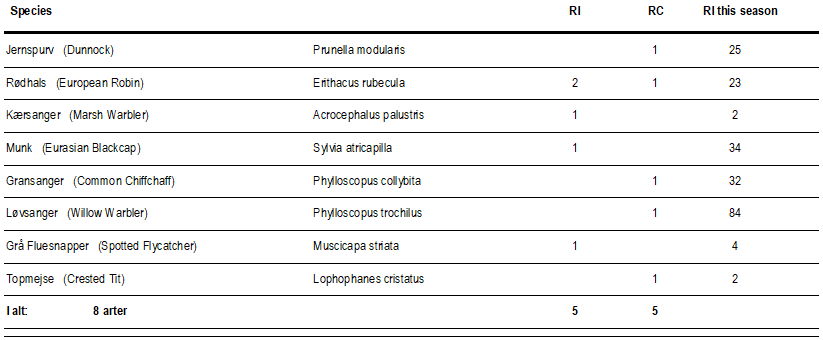
Because of the risk of rain, there was no standard ringing today. The nets were first opened after the Wryneck was spotted, but with it not heeding our wishes and instead staying outside of the nets, we were in for a quite boring around 9 hours of ringing in the Station Garden. In spite of only catching 10 birds in total, we did get some slightly interesting species such as the fourth Spotted Flycatcher (Muscucapa striata) of the season, a very nice recapture of a Crested Tit (Lophophanes cristatus), as well as the second Marsh Warbler (Acrocephalus palustris) of the season, which was both a lifer and a first ringed of the species for Strummer.
Today's captures:
At the station: Johan, Strummer, Alba, Kristoffer, Maria
Thank god for umbrellas
lørdag 29. august 2026
Observations:
Today started with another bad forecast. It was supposed to rain a litte bit from the early morning, but was only supposed to be an early shower to get the observers really woken up. We arrived at the hole (military exercise scheduled) at 06:15, and promply opened umbrellas for the initial shower. We could only really start the count fifteen minutes later. The day yielded almost none of the birds we enjoyed yesterday and the day before, but instead we got to enjoy 156 Northern Gannets (Morus bassanus)! The team in the hole fought through a few sturdy rain showers that were not on the forecast, but it was not enough to deter us from having a good day :)
Ringing:
At the station: Johan, Strummer, Alba, Kristoffer, Maria
Yay Brant!
fredag 28. august 2026
Observations:
The days started poorly. I thought last night that the weather wouldn't allow me to complete standard, but the forecast changed. Only slightly. Which meant I had to get out in the rain. The experience was different from the normal, not cold, observations, and in the end the ball didn't even go up, so I could've been sitting warm and cozy in the bunker instead of in the hole. Standard yielded some mixed wader groups, and a lot of Green-winged Teals (Anas crecca) and Eurasian Wigeons (Mareca penelope). Quite decent for a wet experience.
The afternoon I got some company in the Sabines, and we put in 2 decent hours. It was nice to have the volunteer team united on the beach. We had a lot more Eurasian Wigeons (Mareca penelope) come, and as a highlight the first Brant (Branta bernicla) of the season! All in all a quite good day.
Ringing:
No ringing today due to strong winds and rain.
Are White-tailed Eagles daily now?
torsdag 27. august 2026
Observations:
Today marked another hard seawatch. I am really finding out that the hardest part about observations at Blåvand is waiting for the birds. Today was eastern wind which might have been good, but migration was slow, with a lot of time between flocks of ducks. Notably we had a decent amount of Eurasian Wigeon (Mareca penelope) and a single White-tailed Eagle (Haliaeetus albicilla) coming to look for snacks. It was a different one from yesterday as this one was a clear 1cy bird. I won't be mad if they're going to be new dailies for me. Very majestic.
Rain tomorrow looks like standard won't be able to be completed, but with rains stopping quite abruptly around 9am, we are brewing up some lethal Sabine hours tomorrow. stay tuned.
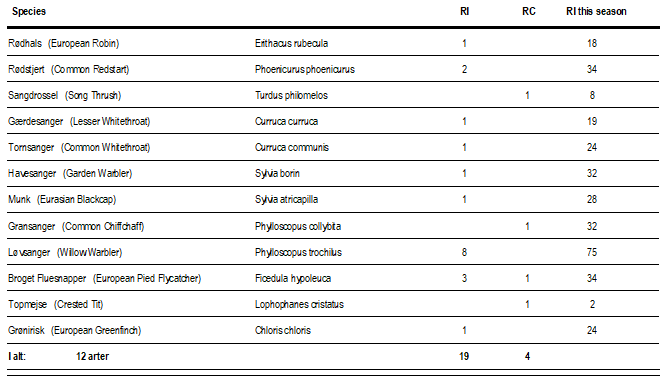
Ringing:
Todays ringing was certainly slowing than the previous few days but still we had a decent movement of migrants. By far the most numerous species were Willow Warblers (Løvsanger) with 8 birds ringed. Besides that it was a relatively quiet day without too many highlights.
This will likely be our last standard ringing day for the forseeable future as the next week predicts consistent showers during the morning.
Shifting baseline
onsdag 26. august 2026
Observations:
The morning wasn't exacly crazy today. I think we are kind of in a weird middle stage where most of the waders have gone, and we're still waiting on the big duck numbers. The day did provide a decent number of Eurasian Wigeons (Mareca penelope) in that category. The highest number was provided by Great Cormorants (Phalacrocorax carbo) funnily enough. 478 passed me on the tip, and in almost one entire flock. For a common species, the looks were still quite astonishing. Additionaly we had a White-tailed Eagle (Haliaeetus albicilla) come by, which greatly improved my mood. Always a cool bird :)
Ringing:
Many years ago, the number of small birds in Denmark was much larger than it is today. Back then, certain nature spots would host extremely diverse and numerous populations of birds that could fill out a sound-spectrograph with their varying songs and drown out any background-noise with their combined volume. As time has marched on, however, the environmental impacts of humans have helped reduce those numbers greatly, so now, many of these spots can offer only a small trickle of birdsong compared to the strong stream that used to flow. And while older generations might remember the old glory days and are able to recognize the relative drought of today, newer generations lack that perspective, and when you're used to looking for drops in a desert, that trickle might be percieved as a waterfall. Thus, what used to be few suddenly has become many.
This is an example of "shifting baseline syndrome", where the (often implicit) baseline against which something is measured slowly slides away from its previous value and toward a new one ("many" birds becomes a smaller and smaller number), sometimes so slowly that the observer(s) don't conciously notice until they check what the old baseline was many years ago. This shifting of baselines can happen through generational shifts, where the old baseline dies out with the older generation, but it can also happen on smaller timescales, where it is the fluidity of memory as well as forgetfullnes that lets the baseline slide.
During the last week, we the ringers at Blåvand have also experienced shifting baseline syndrome, though in an opposite manner to the example above. After two consecutive days with between 40 and 50 caught birds, our baseline has been violently rocked from its previous position of anything over 20 birds being considered a fantastic day, to being that anything less than 40 feels a bit drab without any unusual species to spice things up. Despite us being maybe a bit ungrateful for an objectively not-too-terrible day, we did enjoy being able to spend a bit more time with each bird again today, and the recapture of a Blue Tit (Cyanistes caeruleus) and the ringing of a new Spotted Flycatcher (Muscicapa striata), both of which being species we have only had a few of so far this season, did add a bit of flavour.
One of my personal highlights of today was actually in the form of a Garden Warbler (Sylvia borin). With the exception of maybe a few birds, all of the Garden Warblers we have caught so far this season have been young birds hatched this year (1k), which we have been able to tell by their very fresh tail- and wing-feathers. However, one of my Garden Warblers from today had tertial, primary and greater covert feathers that were quite worn, indicating that it was an adult (2k+) bird!
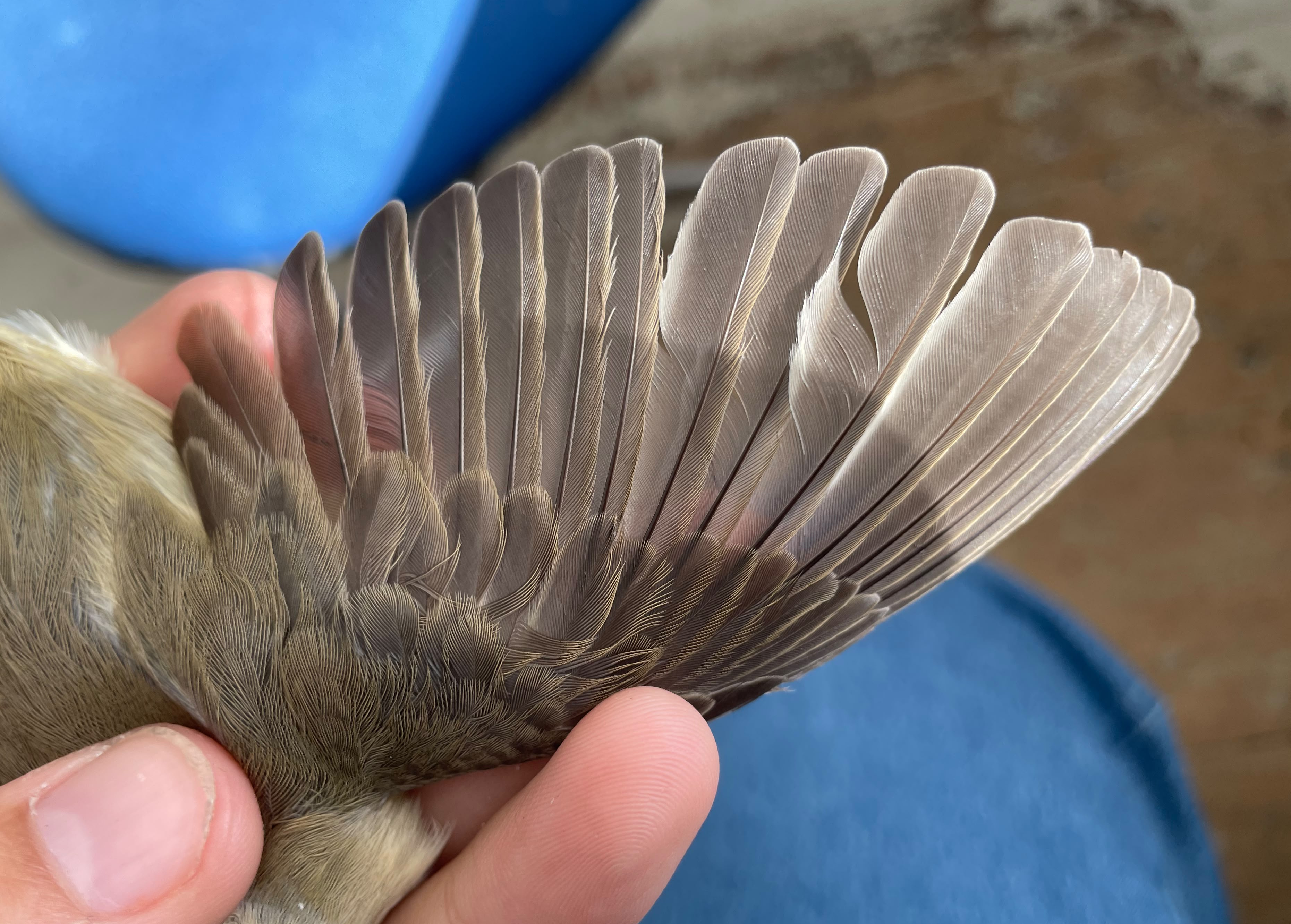
Young (1k) Garden Warbler. Notice the very fresh and un-worn feathers of wing, especially the tertials, primaries and greater coverts. Foto: Strummer Edwards.
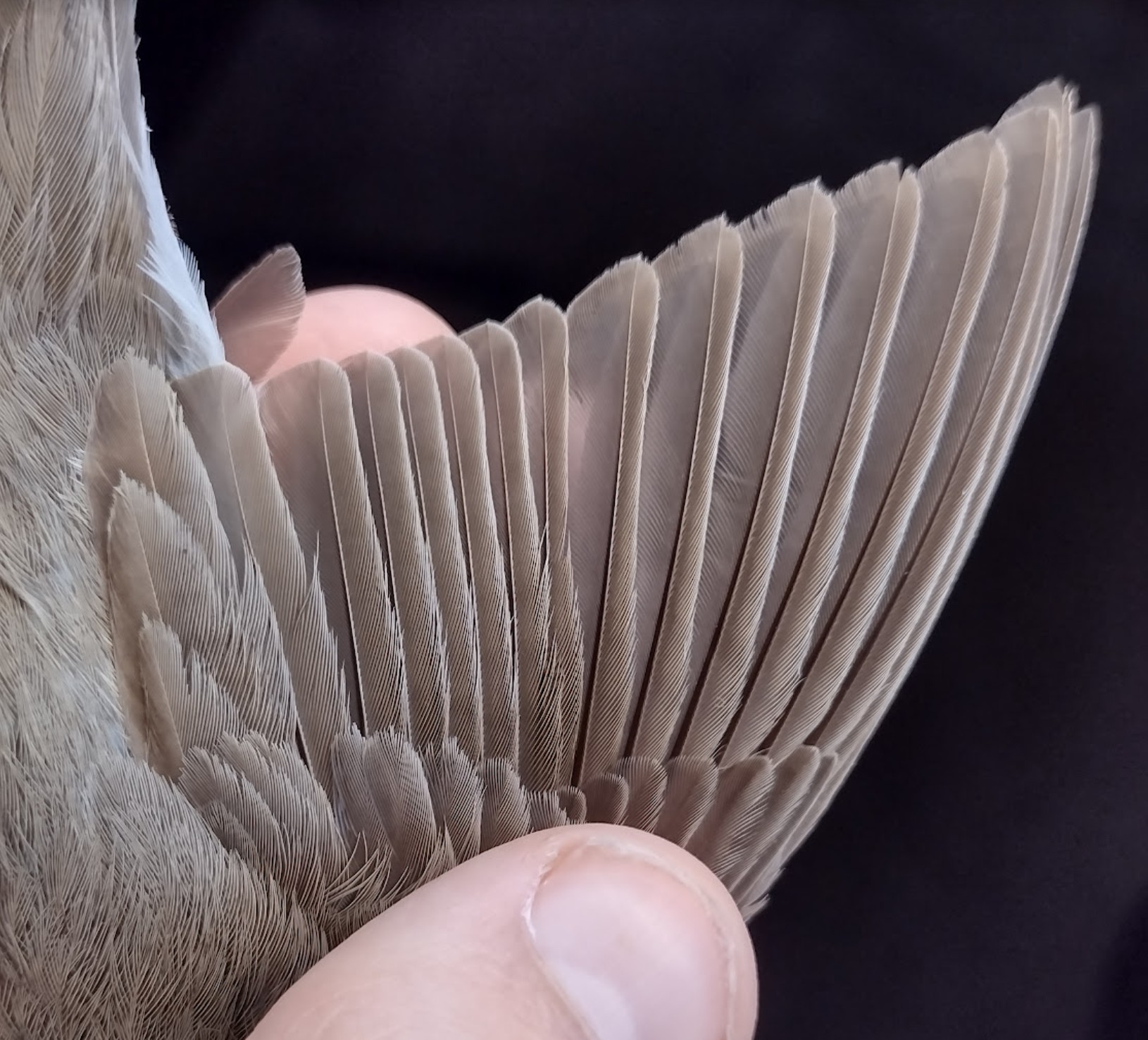
Old (2k+) Garden Warbler. Notice the very worn tips of the tertials, primaries and greater coverts. Foto: Alba M. Holmberg.
Today's captures:
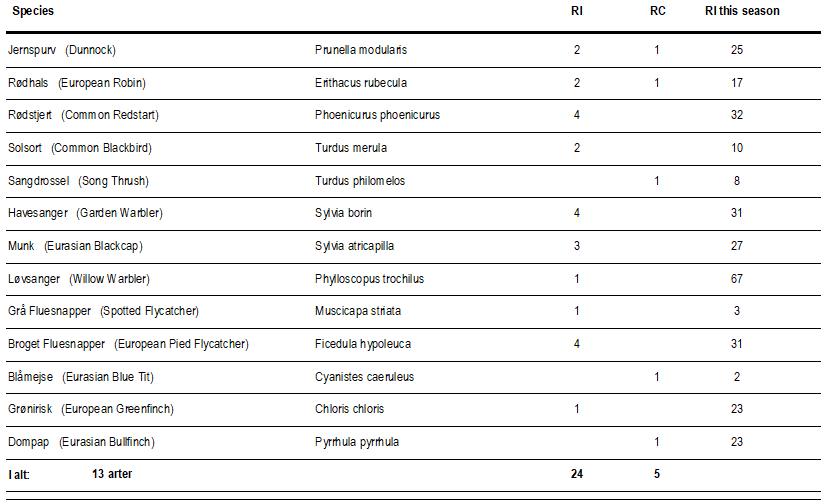
At the station: Strummer, Alba, Johan
Another amazing day at Blåvand
tirsdag 25. august 2026
Ringing
For the second day in a row, we processed around 50 birds here at Blåvand!!! Today was not only filled with lots of migrants but also quite a few nice species we have not been catching in our nets lately. The day featured a consistent flow of birds between the two gardens, with our bulk species being Blackcap (8 birds, Munk), European Pied Flycatcher (6 birds, Broget Fluesnapper), and Redstart (6 birds, Rødstjert). Among the Redstarts we caught, there was also a beautiful DCB male which is always wonderful to get in the hand.
For me, by far the most exciting bird of the day was a Great Spotted Woodpecker (Stor Flægspatte) which I caught in the krat. Despite being very tangled, this was a rather well behaved individual which kept the pecking and screaming to a minimum while I extracted it. Once we got it to the station, it began behaving far more like a standard Spotted Woodpecker, pecking and screaming during the entire ringing process.
This individual was experiencing its FPF so we were able to see the transition from the juvenile crown feathers to the deeper red of the formative adult like feathers behind the crown.
Besides the woodpecker we had many other wonderful captures including our first Blue Tits (Blåmejse) of the season and three Chaffinch (Bogfinke) in the Fyrhaven.
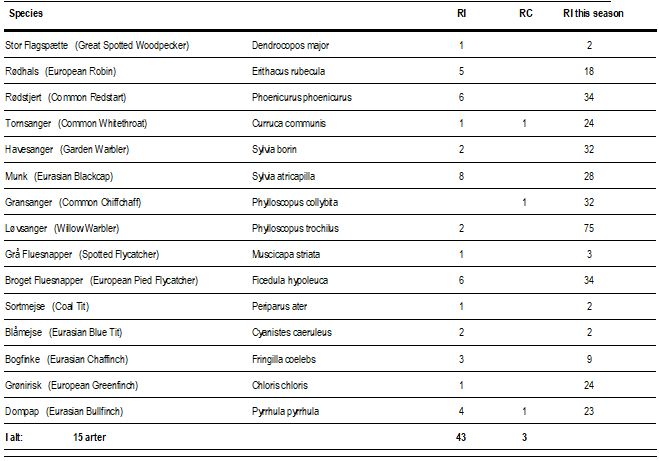
Obs
While observations were conducted by the wonderful talented Johan today, the standard period was so abyssmal he was far too distraught to write the blog post himself so I am relaying that there were no highlights and he hopes for better days soon.
Now the real fun begins
mandag 24. august 2026
Observations:
My first morning with no grownups watching over me went quietly. A lot more silent than previous days but with a good amount Arctic Skua's (Stercorarius parasiticus).
The highpoint of the day was by far a Pallid Harrier (Circus macrourus) coming over us ahead. With me wanting to not miss any waders on my first obs as "responsible observer" I spotted it quite late. Luckily we got some pictures could see that it wasn't just a hen or marsh harrier. There were some doubt about it maybe being a Montagu's harrier (Circus pygargus) as the dark on the outer primaries looked a bit too strong, but doubts were dismissed in the end. A good observation on a quite dull day.
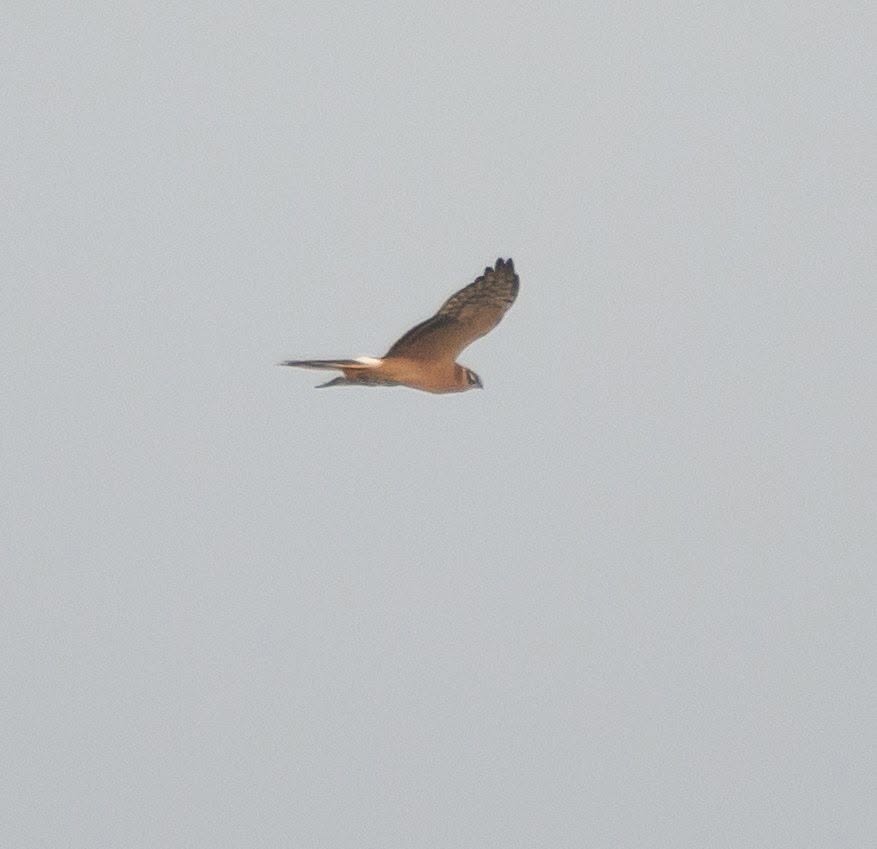
Pallid Harrier photographed by Sebastian Dreisig
Ringing:
Today marks a great day for the Blåvand autumn season of 2026: We finally reached 50 birds caught in a day!!! After a whole two days with strong winds and no ringing, the conditions have finally imroved enough for nets to be opened, and, evidently, for small birds to resume migration. The day started with decent numbers of Willow Warbler (Phylloscopus trochilus) and Common Redstart (Phoenicurus phoenicurus), most of them with decent fat scores, which indicates that they are in good condition to migrate. Through the morning, I started to pick up on the sad-sounding calls of Bullfinches (Pyrrhula pyrrhula) flying around in the Lighthouse garden, and sure enough, soon I started getting juveniles in the nets.
About an hour before standard was set to end, I got the bird of the day, also in the Lighthouse garden: It was a Great Spotted Woodpecker (Dendrocopos major)! I had to take it down to the station to give it a steel ring on, and in the process I got to show it off to Strummer, who had never seen it in the hand before, and Johan, who had just returned from observations. In the process of handling and taking picutres of the bird, it managed to give me a good few pecks in the hand, giving it the honor of being the first bird in Blåvand this season to make me bleed!
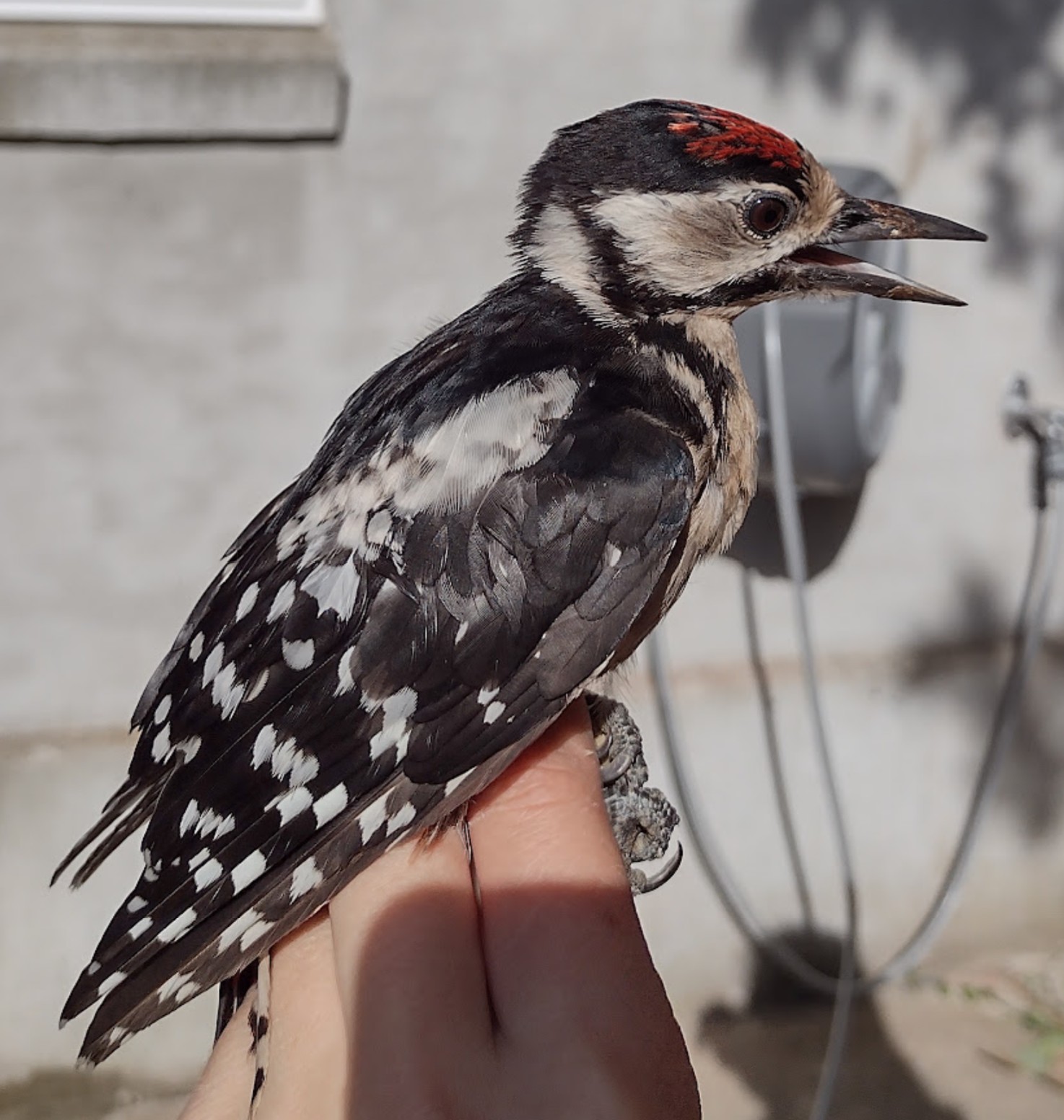
Juvenile Great Spotted Woodpecker. It can be recognized as a juvenile bird by the red patch of feathers on its forehead. Adult birds have a black forehead, and adult males have a red patch at the nape, while the female has no red feathers in the head. Foto: Johan Them Steffensen
We held the nets open for a few hours after standard was done, in the duration of which we managed to catch a few more young Bullfinches (some in complete juvenile plumage and others undergoing their post-juvenile moult) as well as some assortment of other birds. After all was closed and done, we had managed to get a whole 50 birds, a new record for the season!
Today's captures:
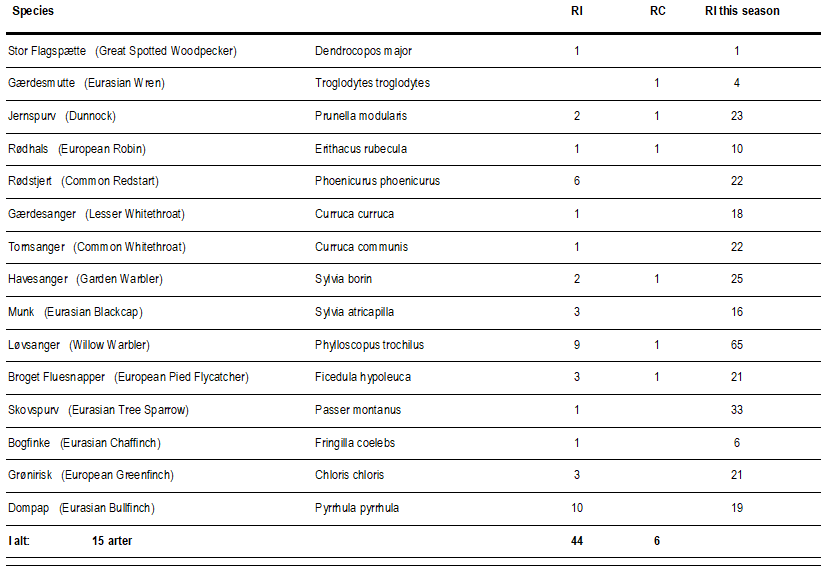
At the station: Strummer, Alba, Johan, Alex, Sebastian, Mikkel
An uneventful day starting in the Sabines
søndag 23. august 2026
Ringing:
No ringing due to strong winds and intermittent rainshowers.
Observations:
Another day with strong northwestern winds and small rainshowers, another day with observations from the Sabines bunker. This time, it was just Jonas and I (Alba) that went out to the bunker early in the morning, since both Johan and Strummer had slept quite poorly that night. While I usually prefer ringing to observations, it was really fun to shake things up a bit and enjoy looking at birds from a distance. Although it wasn't a particularly interesting or busy round of standard-obs, I still really enjoyed brushing off some of the rust when it comes to sea-obs, as well as getting the opportunity to practice identifying shorebirds (and a few ducks) in flight.
About halfway through standard-obs, Johan and Strummer joined us, and for the first time this season we had the whole volunteer-team united in the Sabines bunker.
The highlights for me during standard-obs were a very pretty Arctic Skua (Stercorarius parasiticus) that flew by just in front of the bunker, granting me the best view I've had so far of this species, as well as a young Black-legged Kittiwake (Rissa tridactyla) that also flew quite close.
Shortly after observations were done for the day, we drove Jonas to the train-station, since his studies are starting up again next week and he therefore unfortunately has to leave us. He will be sorely missed.
At the station: Strummer, Alba, Johan & Jonas.
A day in the sabines
lørdag 22. august 2026
With very strong northwesterlies and frequent showers the ringing was dismissed as a possibility.
As such observations was the primary focus of the day. Johan and i were the first to leave however we were unsure of where to place ourselves. Quickly we landed on the sabines bunker as being the best possibility. Alba and her mother came shortly after and the next three hours we counted in the bunker. There was decent wader migration with oystercatcher being the most numerous, but also turnstone and others. As the wind carried on, a decent amount of terns and gulls started migrating aswell. Highligts were 7 arctic skuas and a 1cy mediterrenean gull.
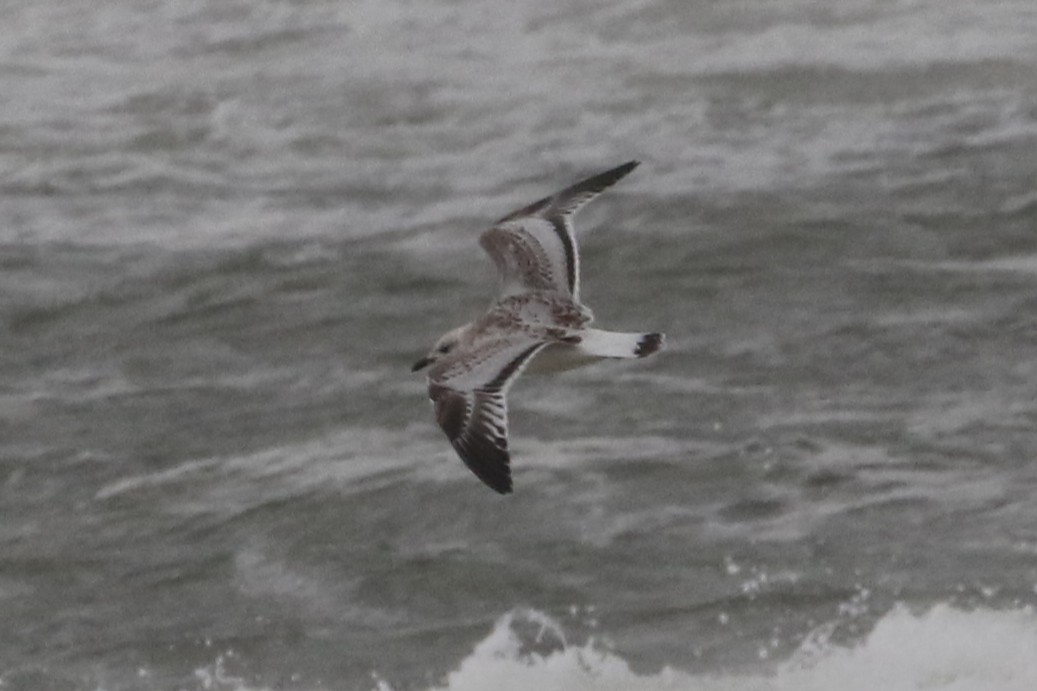 (One of the days three 1cy mediterrenean gulls showed its lovely wing pattern and droopy bill nicely)
After standard we returned to the station for coffee, bread and some resting.
As it is my last full day i was keen to get out and see if the wind could bring some seabirds. As such Strummer and i went to the Sabines again for some obs.
The wind was very strong at this point and again, skuas, terns and gulls were migrating nicely. Also some waders.
At one point i glimpsed a larger seabird for a quarter of a second and got quite excited as i thought first it looked like a larger shearwater. The bird dissapeared completely though! But a bit later it revealed itself as a fulmar, the bird would be a lifer for Strummer but this one, and the next would prove to be quite difficult to see. We did however see a third one which gave great views going south. Lifer for Strummer! 
(LIFERRRRR)
We were pretty happy but short of a minute later Strummer saw a Skua migrating south quite close. We quickly ID'ed the bird as an adult long tailed skua. WHAT A BIRD!! The adults are rare and look incredible. Another lifer for Strummer and a super cool minute of seawatching, i managed to get some good shots of the bird: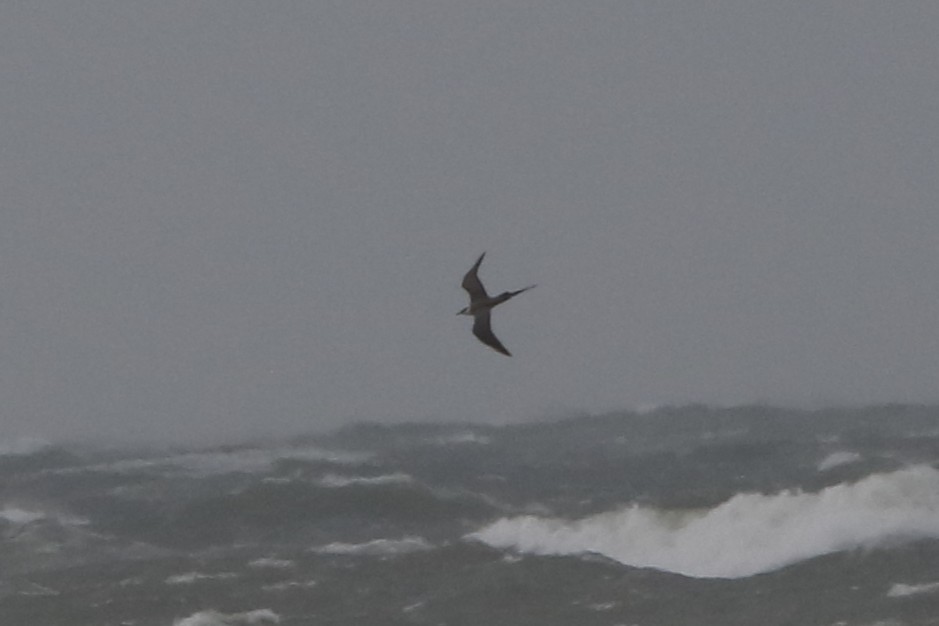
(Adult long-tailed skua with its awesome tail extensions)
We continued for a while more hoping for storm petrels but 2 mediterrenean gulls were what the seas could bring.
All in all a super cool day!
Tomorrow is more wind and we hope for more seabirds!
At the station: Strummer, Alba, Sessan Holmberg, Johan og Jonas.