
Her på Blåvand's blog bringes korte nyheder i dagbogsformat om livet og hændelser på fuglestationen.
-
FORSIDE

- Blog
Se indlæg fra måned: mar. (31)apr. (30)maj (31)juni (16)juli (18)aug. (32)sept. (30)okt. (13)
And the heavens opened up
fredag 21. august 2026
Observations:
The morning was incredibly boring but we did get 2 Caspian Terns (Hydroprogne Caspia) right when we arrived. I won't bore you with the details as the days undisputed highlight happened in the ringing.
Ringing:
Today had the greatest ringing moment of my life. Doing the lighthouse runs today, they remained relatively slow with only 1-2 birds with each net run. With the generous wind conditions repeating itself, we were able to open all nets which helped ease my mind over potentially missing birds at the lighthouse. For the first few hours, the only hightlights were a few first cycle Willow Warbler (Løvsanger) and an early Blackcap (Munk).
At 6:45 I got the most important text of my life. When I had just started the run at the lighthouse garden, Alba sent me this:
Being a diligent ringer, I made sure to complete my run while Alba held the wood pigeon (although I may have finished the loop in a brisk jog to full on sprint). Once I reached the station garden I ran into the ringing room where I saw Alba holding up a massive bag. Being the incredibly generous and kind ringer she is, she decided to allow me the immense honor of ringing this magnificent bird.
Ringing it with the massive steel ring was a bit of a challenge but the entire experience of ringing it was so unbelievable it can't be properly described. Aging it was also a bit complicated, we ended up settling on it being an early breeder from this year which had already completed its FPF moult.
Afterwards, we took it into the garden to take photos (pictures TBD) and admire it a bit longer before releasing it to create more Wood Pigeons. The rest of the day after that offered few birds however nothing would have been able to top the high of having this amazing bird in hand.
At the station: Strummer, Alba, Jonas, Johan, Henrik
Whinchat!!!!
torsdag 20. august 2026
Observations:
A steady day with not too crazy numbers. We again had the company of David at in dunes, but the big numbers or species didn't really show up. To not keep ranting about Eurasian Oystercatchers (Haematopus ostralegus) and Red Knots (Calidris canutus) we could mention that we did have 10 Common Shelducks (Tadorna tadorna) across the beach and 3 Red-throated Loons (Gavia stellata) who are slowly turning up these days.
After reloading on coffee and sleep after standard, Jonas and I went for some bush bashing in the early afternoon. With the ball up we weren't able to go to the spiciest areas, and the results agreed. We had a Spotted Flycatcher (Muscicapa striata) and some Northern Wheatears (Oenathe oenathe), but nothing that really got the adrenaline goin'. Jonas noted that it is maybe the time he has had in Blåvand with the least birds, but noone can say that we're not putting in the work.
Ringing:
With winds having died down to mere 3-4 m/s, we were able to open all of the nets in both the Station and the Lighthouse gardens. The last while, the very first round of standard has been empty more times than not, so when Strummer and I each got a European Robin (Erithacus rubecula) in the very beginning of the day, we got our hopes up for a not-too-boring day (at least by Blåvand standards). Though we have seen busier days, we still got decent numbers of birds, with my runs at the Lighthouse producing on average a bit more than 1,5 birds per round.
Then, on the second-to-last round of standard time, I saw two birds hanging in the net that comes just after the Helgoland trap. First, there was a European Stonechat (Saxicola rubicola), but as opposed to all the other Stonechats I had caught before, which were juveniles, this one had the unmistakeable markings of an adult-like male!
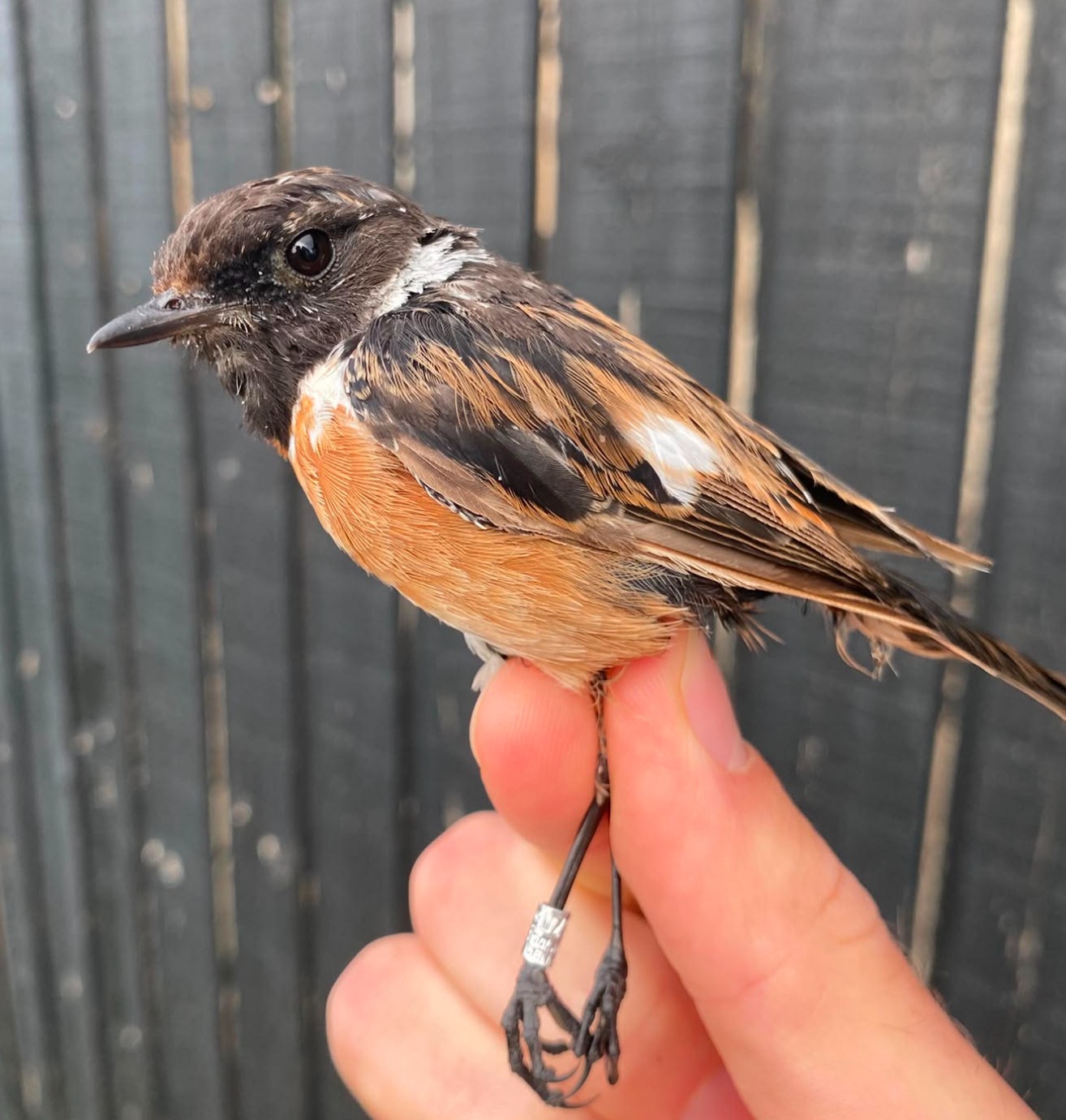
Adult male European Stonechat. The reason he looks so scruffy is because he is in the middle of his post-breeding moult, so he is in the process of changing all of his feathers. Foto: Johan Them Steffensen
Already giddy with excitement, since we've been hoping to catch one of these for a while, I extracted this bird, but when I went over to the other, which I had upon a very brief glance assumed would probably be another Stonechat, I noticed that it was a bit bigger, had a very pronounced light eyebrow-stripe, as well as white bases to its tail-feathers; it was a Whinchat (Saxicola rubetra)!! I very excitedly texted Strummer about it and finished the round, which also produced the first Spotted Flycatcher (Muscicapa striata) of the season, before going up to the laboratory to ring the birds, where I was joined by the whole Blåvand volunteer gang who all wanted to see the Whinchat (it was even a lifer for some of them).
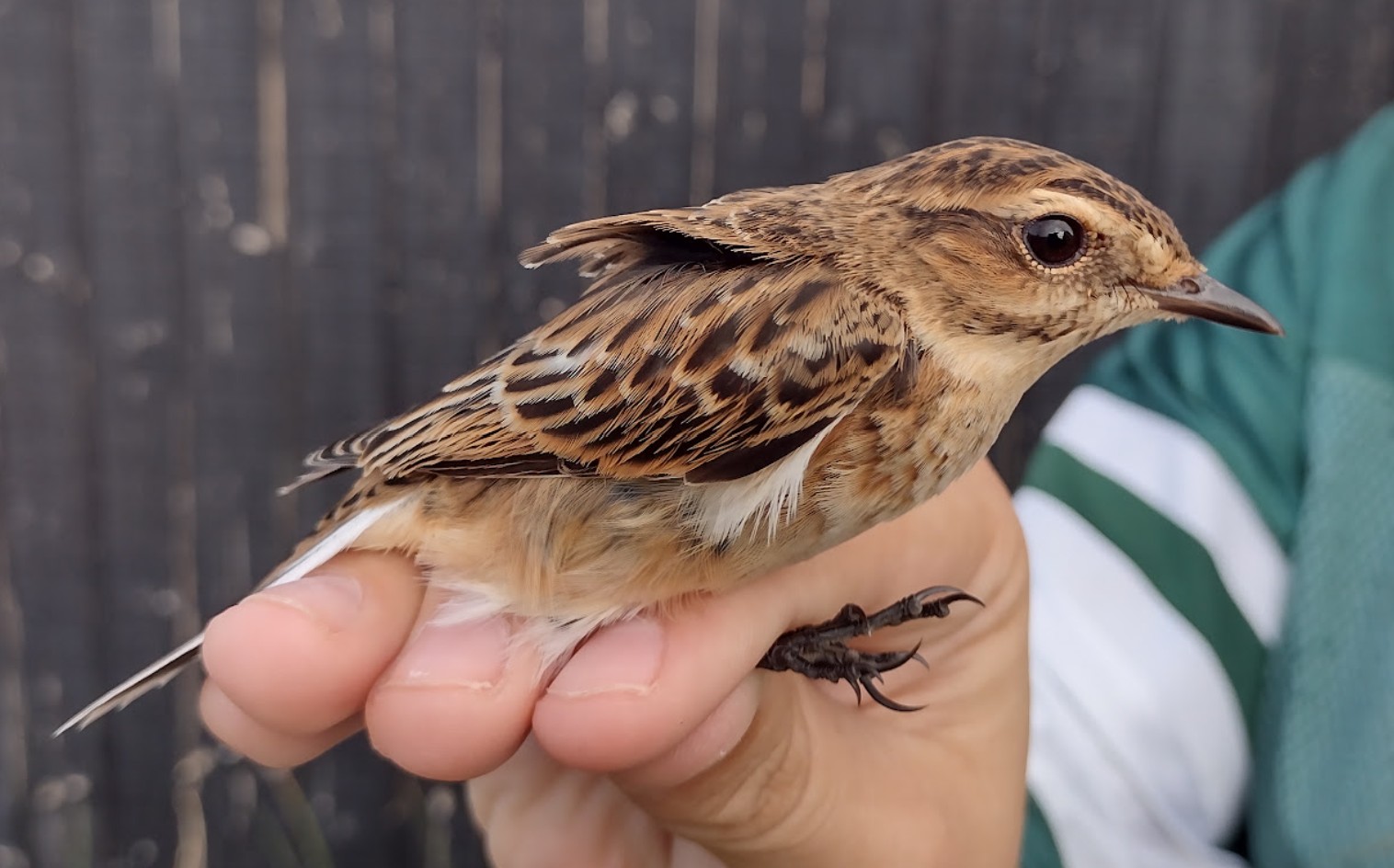
Young male Whinchat. This is the first time this species has been caught in Blåvand since 2023, and it was a new lifer for both Strummer and Johan, as well as the first time I have handled it/seen it handled. Foto: Alba M. Holmberg
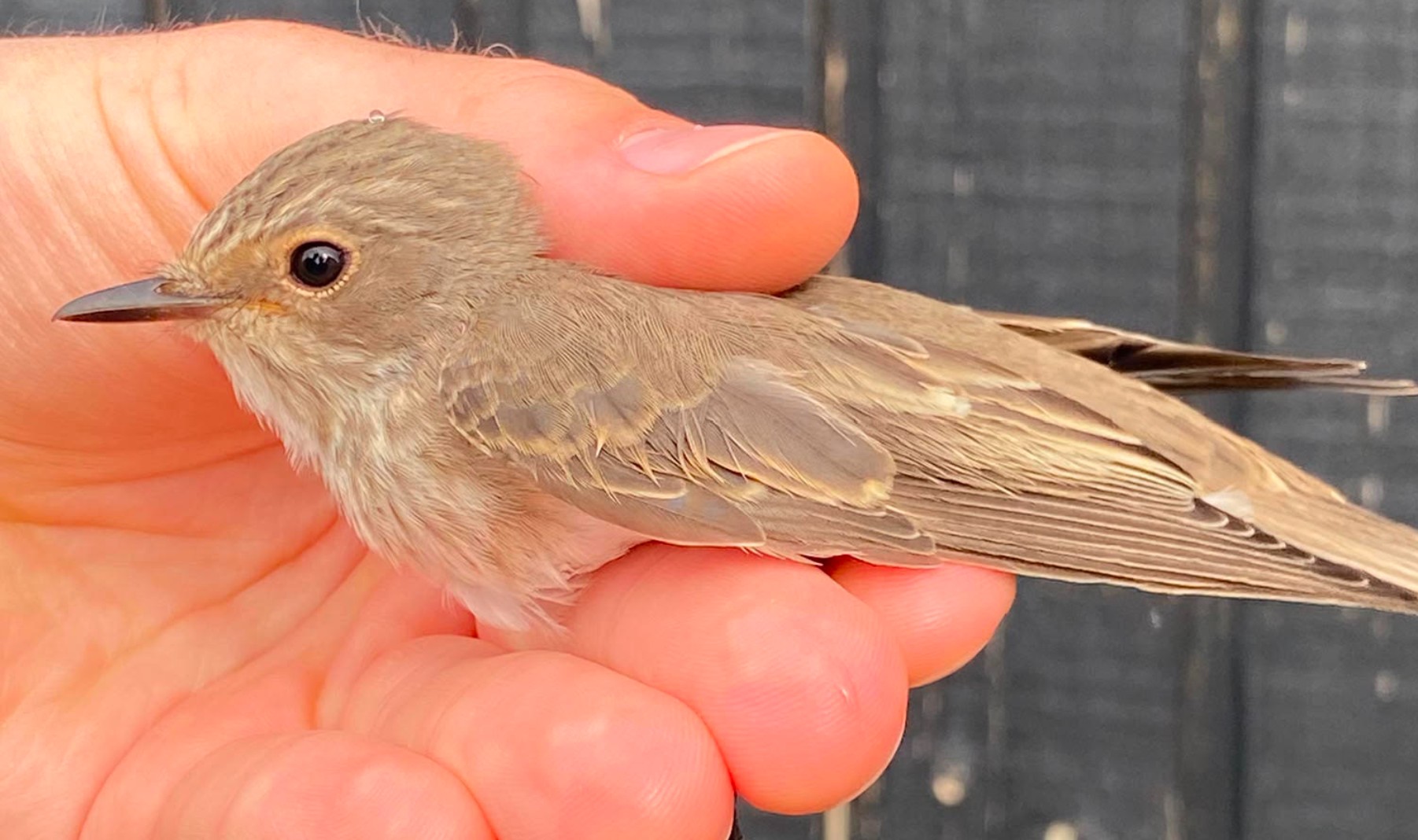
Young Spotted Flycatcher, the first for the season in Blåvand. Photo: Johan Them Steffensen.
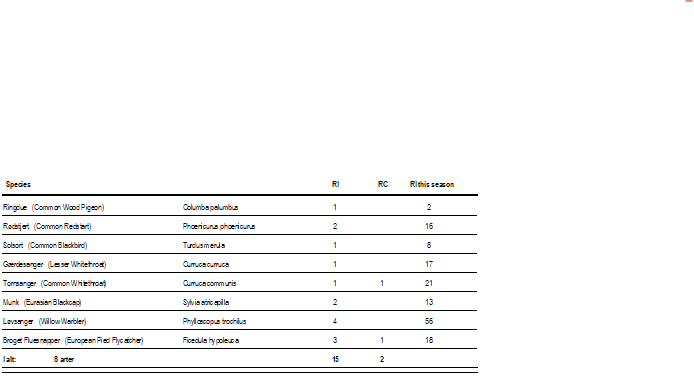
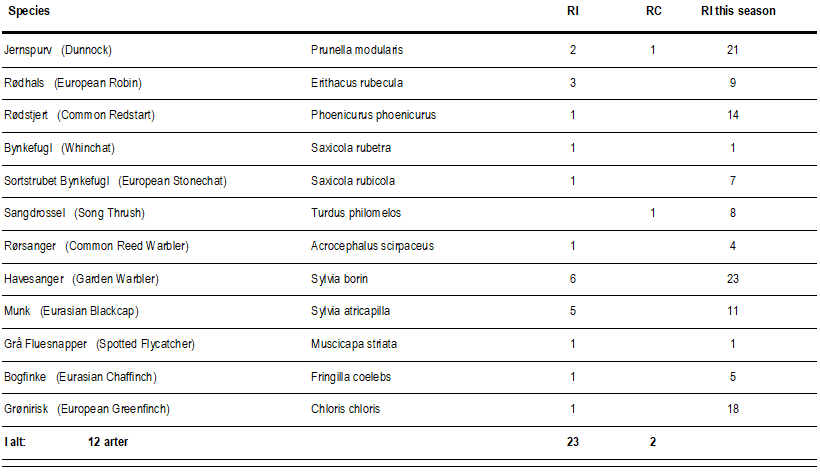
After this, we did not catch much else of note before a sudden rainshower coming out of nowhere forced us to close the nets. Although the numbers weren't crazy, with 25 birds caught in total (23 new and 2 recaptures), the Whinchat has elevated it to one of the most exciting standard-days of the season so far in my eyes.
Today's captures:
At the station: Strummer, Alba, Jonas, Johan, David Manstrup
A day saved by good company
onsdag 19. august 2026
Observations:
The 19th August 2026 is would not be a day that would go down in the record books for Blåvand huk. At 5:45 we trodded out towards the hole once again and acclimated ourselves as the forecast promised some strong winds that would maybe with time blow in some seabirds. The forecast was “amended”, and we got let down.
Luckily for us we had the company of David to keep our spirits high. We needed this as the ocean kept sending parts of its water over our heads in aggressive bursts.
After standard I headed home to lead the coffee project. David and Jonas returned after approx. 40 minutes and got greeted by Bent and I starting on the coffee. The highlight of the day was probably the good conversations over the same coffee today.
The birds today looked a lot like they’ve done all week. A steady stream Oystercatchers (Haematopus ostralegus), Red Knots (Calidris canutus) and Bar-Tailed Godwits (Limosa lapponica) and two beautiful Grey Plover (Pluvialis squatarola) paints a picture of a decent but not impressive morning.
Ringing:
After another early morning just barely scraping by for standard time, we had around 100 meters of nets open. After zero birds in the first two hours of the morning, our extremely exciting ringing efforts were interrupted by rain pouring down on the gardens. We decided that closing nets was the best call and both of us caught up on some well needed sleep.
Later in the day, we reopened station nets after the weather had cleared. For hours, our only capture was a dragonfly sp until the last round brought us our three birds of the day, by far the most notable being a Reed Warbler (Rørsanger).
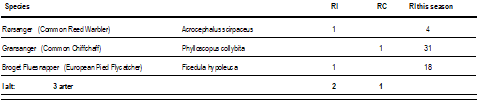
A nice break from the slow days
tirsdag 18. august 2026
Obs:
As the wind had died down during the night expectations were higher than previous days. I might even dare to say that the expectations were met as we had rather a good wader day. A good amount of oystercatchers were migrating past all morning and quite many turnstone too. Red knots showed in some decent flocks and there was a steady flow of dunlin all throughout the obs. We were pleased enough to stay an extra hour but then things slowed down rather much. We did a quick count of the beach which once again held a 1cy Mediterranean gull.
After obs Johan and I went for quite a birding trip through the outer dunes and checking the bushed along there. We had some willow warblers, pied flycatchers and there seemed to be a decent fall of wheatears.
Tomorrow the wind will pick up from the western corner again. Perhaps seabirds, perhaps not? We will find out:)
Ringing:
Also at the ringing we had decent numbers. While Strummer got their turn at catching a bunch of Willow Warblers (Phylloscopus trochilus), many of which were 2k+ (adult) birds, up at the lighthouse, I tended the nets at the station garden, which produced a decent mix of birds, among them a young male Blackbird (Turdus merula) recapture, as well as some Yellowhammers (Emberiza citrinella), Icterine Warblers (Hippolais icterina) and Pied Flycatchers (Ficedula hypoleuca). The highlight for me was no doubt the two young Bullfinches (Pyrrhula pyrrhula) I caught, one of which was in complete juvenile plumage while the other was just starting on its post-juvenile moult, with a few bright red moulted feathers on its cheek and breast revealing it to be a male.
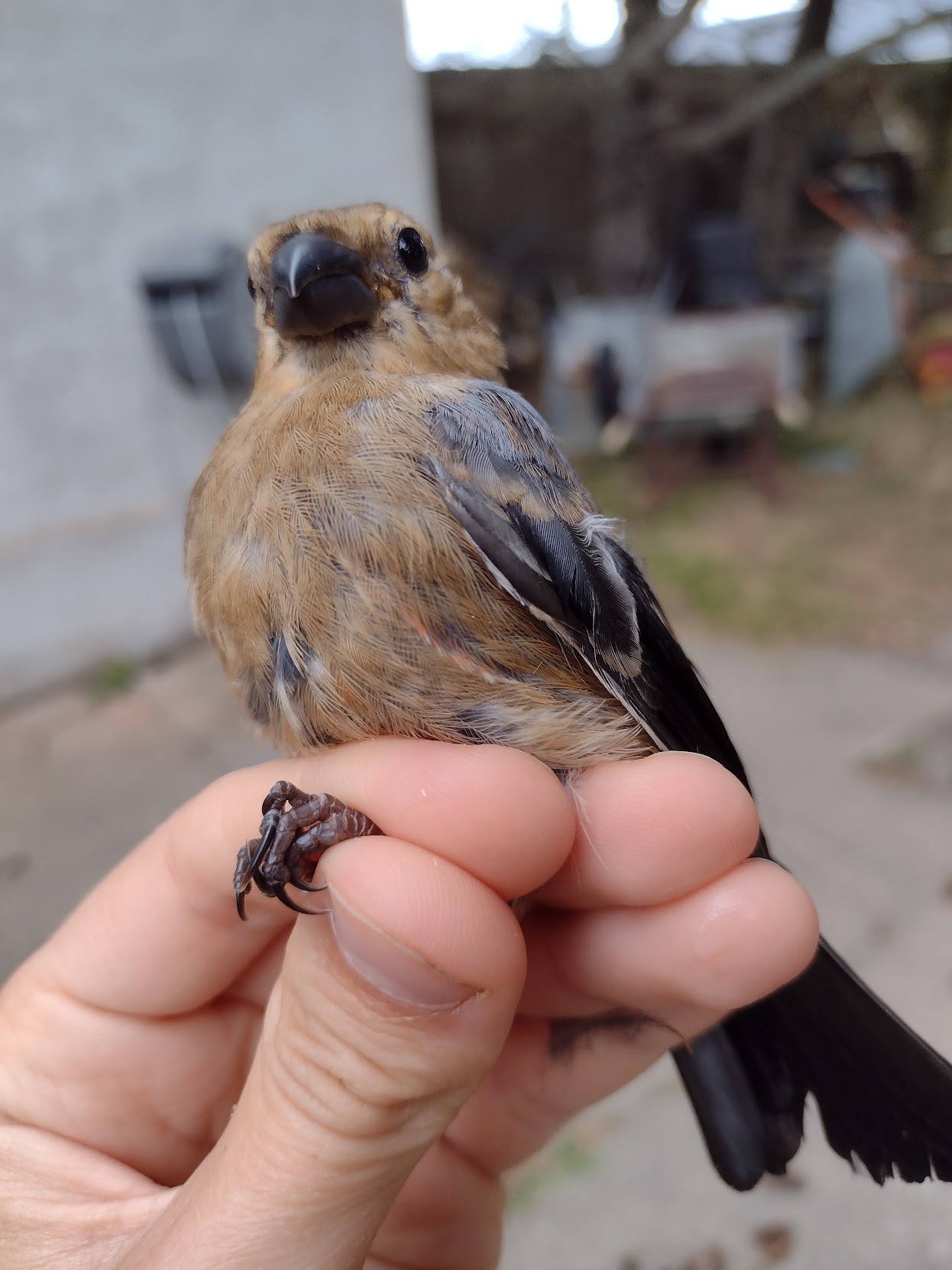
Young male Bullfinch still in mostly juvenile plumage, but with a few adult-type red feathers showing on its flank. It had another such feather on its cheek, but the bird insisted on looking at my phone when taking pictures, so I was not able to capture it. Foto: Alba M. Holmberg
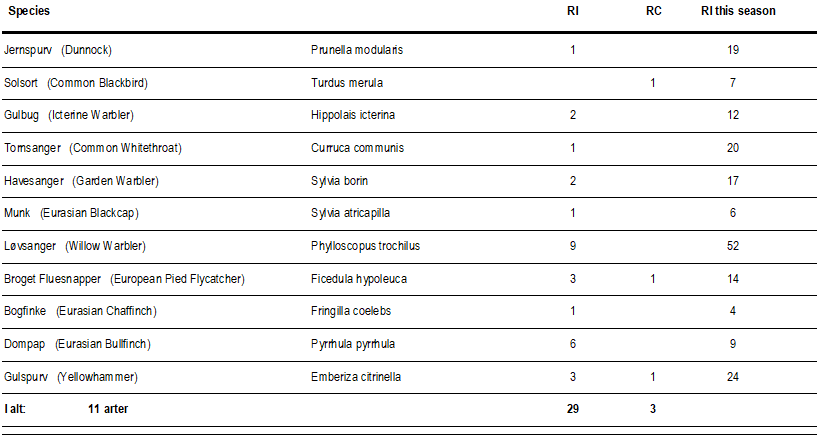
After standard, we were starting to run low on bird-bags, but I kept the station garden open for another hour to get just a bit more out of a good day, and to use the last clean bags before washing them after net-close. In total, we ended up catching 34 birds, of which 29 were new birds and 4 were recaptures (one of them was the Chiffchaff (Phyloscopus collybita) from Spain, which is not included in the overview below). Although it wasn't many birds by many standards, compared to most recent days out here at Blåvand, it has been a very good day indeed!
Today's captures:
At the station: Strummer, Alba, Jonas, Johan
It's all relative right?
mandag 17. august 2026
Observations:
Oh gee what a day. The wind was again north-western so Jonas and I weren't too positive trekking to Böhmers hole. For me the day could only really be good as I have been missing active birdwatching from my time at the nets, and not having to wake up for net open at 5 has it's own charm.
With not too many birds throughout standard, we passed the time by chatting and notifying dog owners that their dogs should be leashed. During the chatting we did agree that today's numbers were a bit better than yesterday. This included 416 Eurasian Oystercatchers (Haematopus ostralegus), 15 1cy Red Knots (Calidris canutus) and 7 Eurasian Teals (Anas Crecca).
The absolute highlight of today came in the form of a Great Skua (Stercorarius skua) migrating south. The species which previously was quite common has in recent years become rather infrequent due to the population being challenged by bird flu in the early 2020’s.
After obs we checked the beach. There were more waders today but fewer gulls. A resting 1cy Mediterranean gull (Ichthyaetus melanocephalus) was a nice bird on the beach.
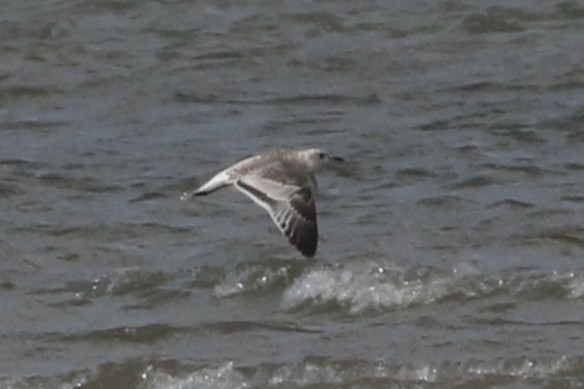
(1cy Mediterranean gull (Ichthyaetus melanocephalus))
After obs we did some cleaning and data work.
Tomorrow the wind will drop during the morning but stay in the western corner, perhaps the afternoon could be good for nocturnal passerines? We hope so.
Ringing:
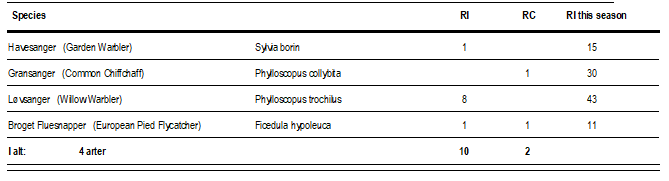
After many tortorously slow days of ringing here at Blåvand, we finally broke ten birds processed! Alba was in the Fyrhaven which had nine birds, including eight Willow Warbler (Løvsanger), making for an exciting morning up at the lighthouse. Among these, we had multiple 2k+ birds which were wonderful to see!
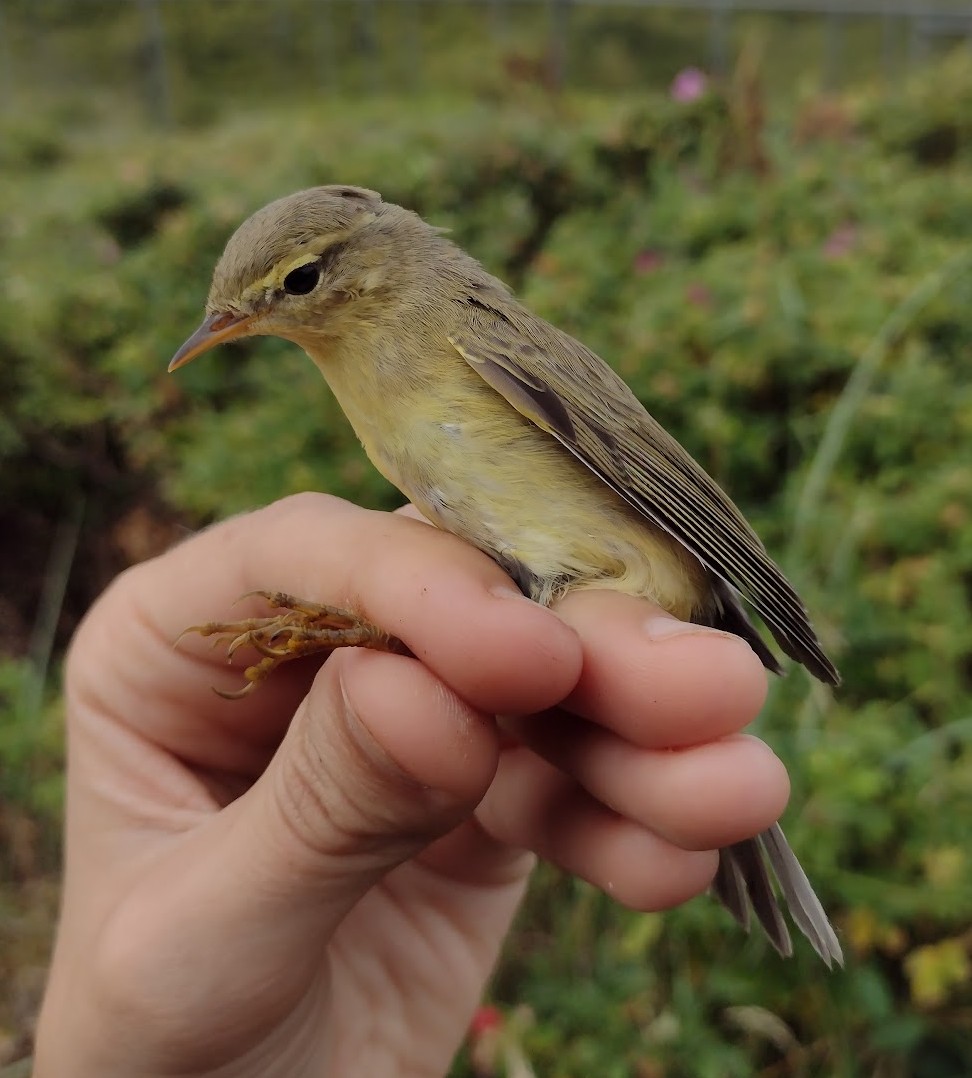
A typical 1k (young) Willow Warbler with lots of yellow on its stomack and flanks. Foto: Alba M. Holmberg
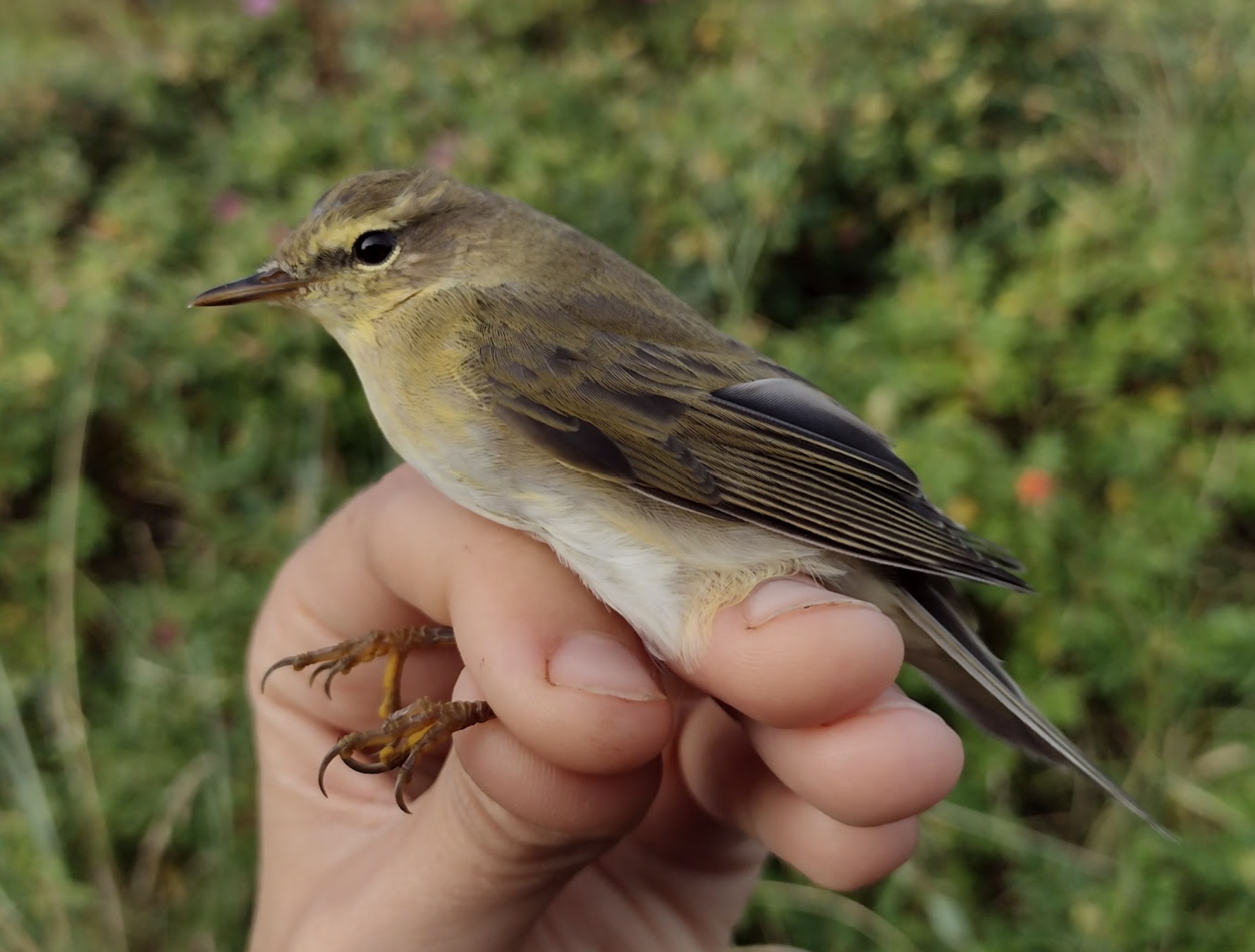
One of the adult (2k+) Willow Warblers of today, with only thin streaks of yellow on otherwise overwhelmingly white stomack and flanks. Foto: Alba M. Holmberg.
Unfortunately for me, I had the station this morning which made for a far less engaging experience. Ending the morning with only three birds, it was a rather dull ringing experience. Thankfully I got my first ringed Garden Warbler (Havesanger) which was a highlight.
At the station: Strummer, Alba, Jonas, Johan
Difficult northwesterlies
søndag 16. august 2026
Observations:
Taking over for the Totos today was no easy task. Not because of the amount of birds, that was a rather modest affair. But there was an incredibly large amount of water in the ocean. It was extremely difficult to count and it took up most of the standard time. Me and Johan were in complete awe of how much water an ocean really can hold on a good day!!!
Jokes aside the obs was a rather dull time. Very few waders and much less of anything else. Just about 50 oystercatchers, a flock of turnstone and a 1cy Mediterranean gull was the most exciting mentionables. As it was Johans first time counting we talked a bit about the process and discussed ageing waders and such. After some time Johan went back to drive the Totos to Oksbøl so they could start the journey home, thank you for a nice time guys!
After standard I checked the beach, not many gulls were resting and the number seemed to decrease exponentially with every dog-walker that appeared on the beach. Quite many of the gulls were however Caspian of adult, 3cy and 4cy ages. Also 7 wheatears foraging in the sea waste was nice.
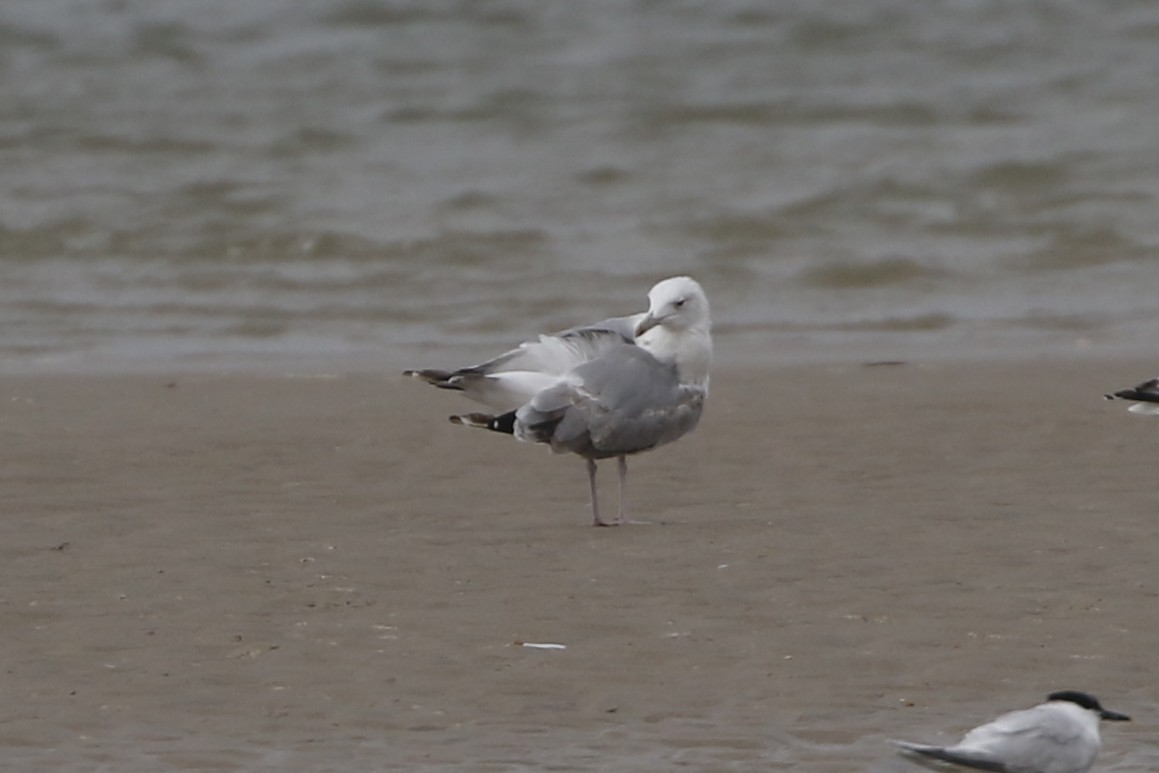
(3cy Caspian gull preening reveals it worn outer primary that will soon be shed and replaced in its current active moult. The Caspian gulls will soon seem very short winged as they are moulting the outer primaries.)
In the afternoon I attempted some birding in the bog, it delivered with quite some migrant willow warblers, lesser whitethroats and some resting stock doves
Ringing:
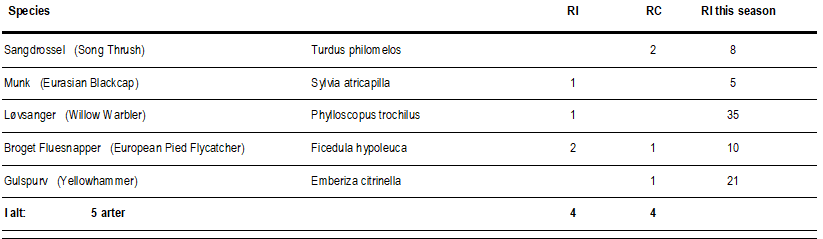
With Jonas and Johan abandoning us for observations (and Ida no longer being at the station :'( ) it's just Strummer and me manning the nets for the next while until Henrik finds someone else to do the counting. Splitting up the two gardens between us, we spent the five hours of standard time catching on average less than 1 bird per hour each, with Strummer catching 3 birds while I got 5. Like yesterday, the Pied Flycatchers (Ficedula hypoleuca) dominated the numbers, but otherwise the highlight was a cute male Blackcap (Sylvia atricapilla) which still had some brown feathers in its crown.
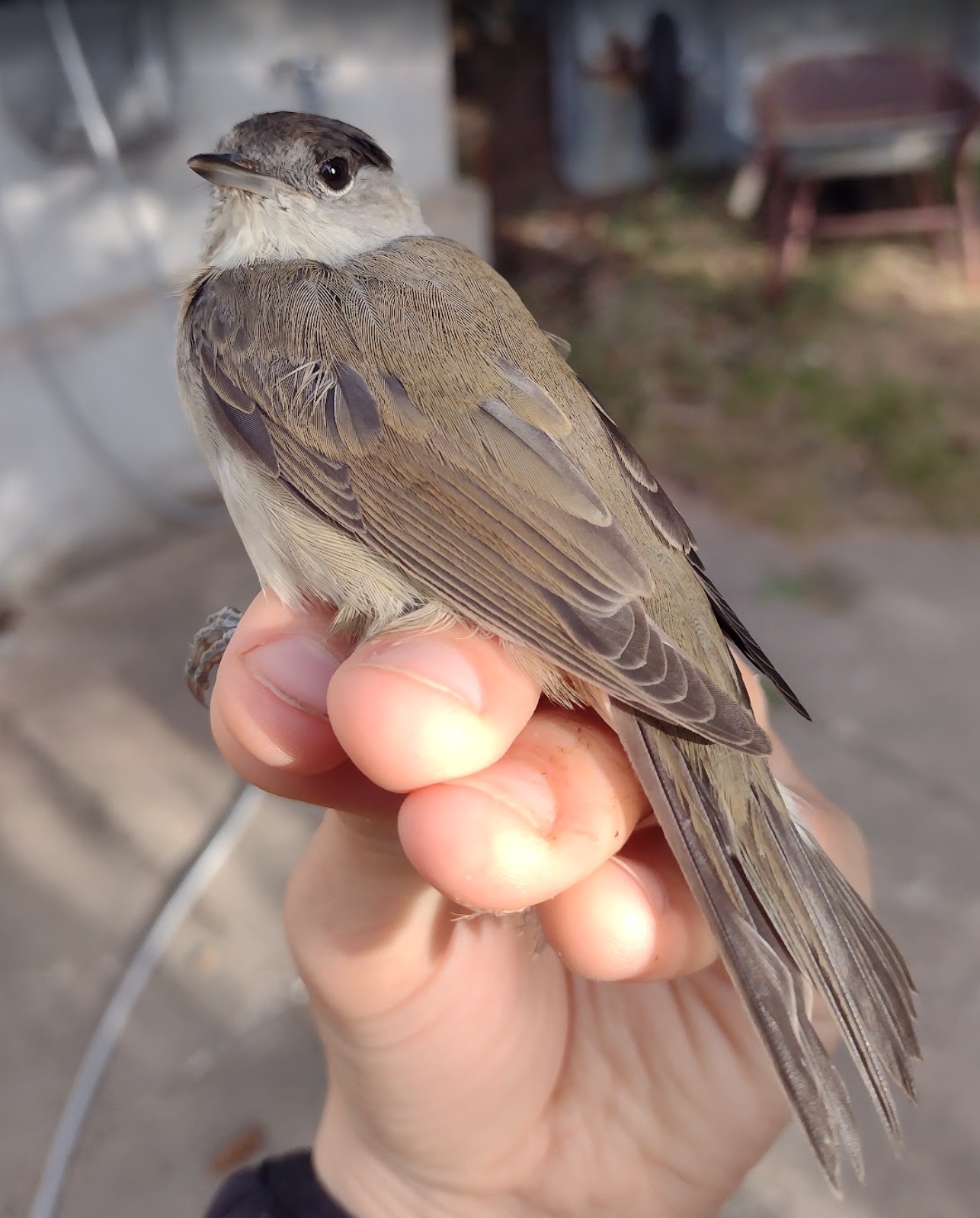
Male Eurasian Blackcap with some brown fringes on its otherwise black crownfeathers. Foto: Alba M. Holmberg
Today's captures:
At the station: Lois, Nicolas, Miguel, David, Strummer, Alba, Jonas, Johan
Hey Little Terns why don't you like us :´´(
lørdag 15. august 2026
Observations:
Today was the last observation day for the Spanish team, as we're heading back home tomorrow. A quite slow seawatch due to the northwesterlies was followed by helping in the removal of the Little Tern fences around the suitable breeding habitat on the beach.
An enjoyable lunch with many people and local food and a goodbye walk around the area were the main thing after the observations, but that was also really nice!
Midday and afternoon brief observations did not provide that much. Not many migrants in the bushes today, and a lot of wind that doesn't help when looking for warblers.
Ringing:
Ringing today was what it was. The wind was quite strong and northwest so none of us were poitively inclined from the getgo but the effort had to be out in. 3 ringed European Fly Catchers (Ficedula hypoleuca) and 1 recap, was some consolation. Every ringer at the station at the moment has them as one of the favourites, so when you only get 4 out 9 total birds in that species you can't be too mad.
After standardized work at the station we had a visit from the people over at the National Park Wadden Sea. They enlisted our help in removing the netting and monitoring equipment from a site for nesting Little Terns (Sternula albifrons).
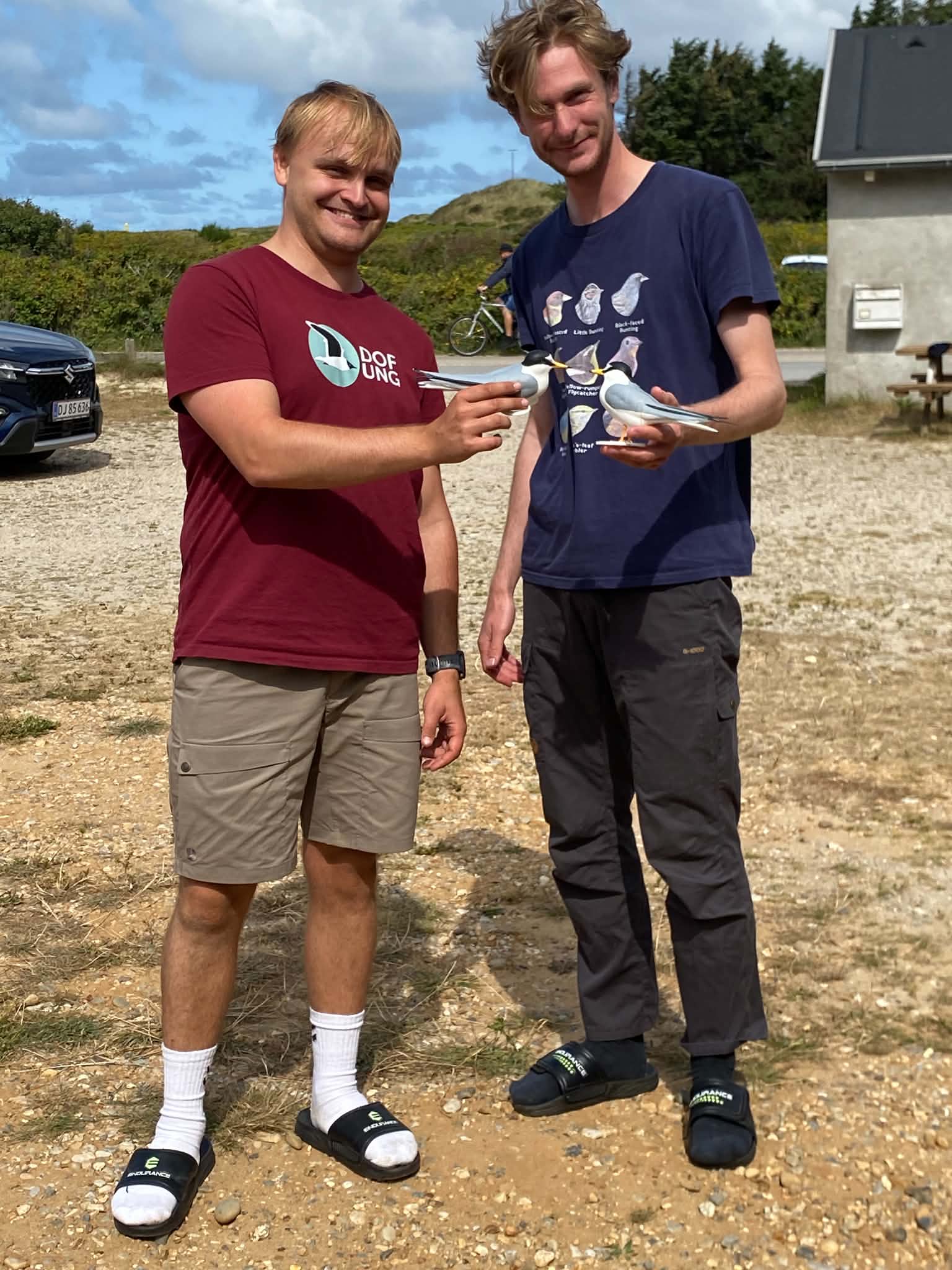 The only Little terns getting it on at Blåvand bird station
Regrettably we haven't had nesting terns this year or the year before, but the same program has seen great success on Fanø island, so maybe next year with revisions we'll get some baby Little Terns (Sternula albifrons) of our own.
We sadly also had to say goodbye to Ida today, as she is headed onwards to greener fields. It has been a joy to have Ida join us for ringing and general good mood around the station, and we're hoping for a return season with more birds for her one day.
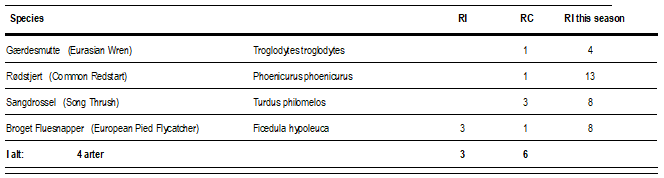
Ringing numbers 15/8
At the station: Lois, Nicolas, Miguel, David, Strummer, Alba, Jonas, Ida, Johan
A calm day and a goodbye dinner
fredag 14. august 2026
Observations:
Marsh Harrier record count! Today, weak to moderate southeast winds in the morning provided good conditions for raptor migration at Blåvandshuk. Totals of the day were 46 Marsh Harriers (many of them heading southwest, out to the sea), 62 Kestrels, 1 Red Kite, 3 Sparrowhawks and 1 Osprey. Visible migration of Yellow Wagtail and Tree Pipit was also seen from the Wader Spot.
Large gull groups (around 5,000 individuals in total) resting and feeding in the low tide gave a good chance to check them: at least 72 Caspian Gulls, mainly adults and advanced immatures. Also a 1K Mediterranean Gull.
Wader migration was not bad, with almost 1,000 Oystercatchers and a good variety of other waders.
Ringing:
It was an interesting day for the ringers, with no recaptures all day, but 14 newly ringed birds. We caught a couple migrating Common Redstarts (Phoenicurus phoenicurus), but otherwise the totals were back down to the numbers we've grown used to.
We decided to put up the swallow-net, which rewarded us with two new House Martins (Delichon urbicum), both of them beautiful adult birds.
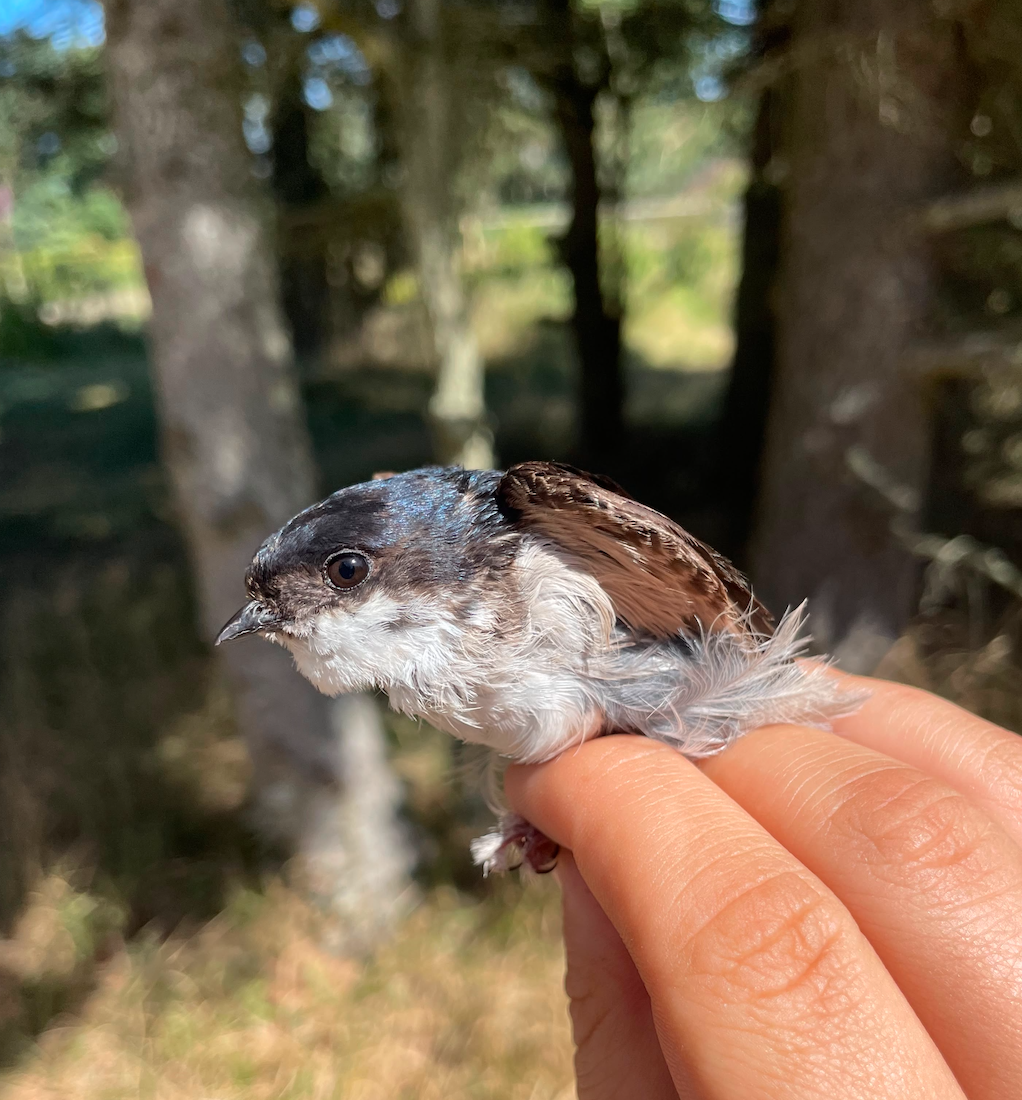
One of the shiny Martins.
Around 5pm, Henrik came to the station for our goodbye dinner, as I will be leaving tomorrow morning and the Totos leave on Sunday. We ordered pizzas and sat together outside, in the nice company of the local House Martins, Tree Sparrows (Passer montanus) and Wood Pigeons (Columba palumbus), while Sandwich Terns (Thalasseus sandvicensis) flew overhead.
When dinner was over, Strummer, motivated by the presence of many Wood Pigeons, turned on our speaker with Wood Pigeon calls and put it under the swallow-net, with high hopes of catching one of them. As all 10 of us waited, watching the net for (in many of our opinion) too long without anything happening, we finally gave up and went our separate ways. Who knows if, one day, Strummer will manage to catch one of the elusive birds.
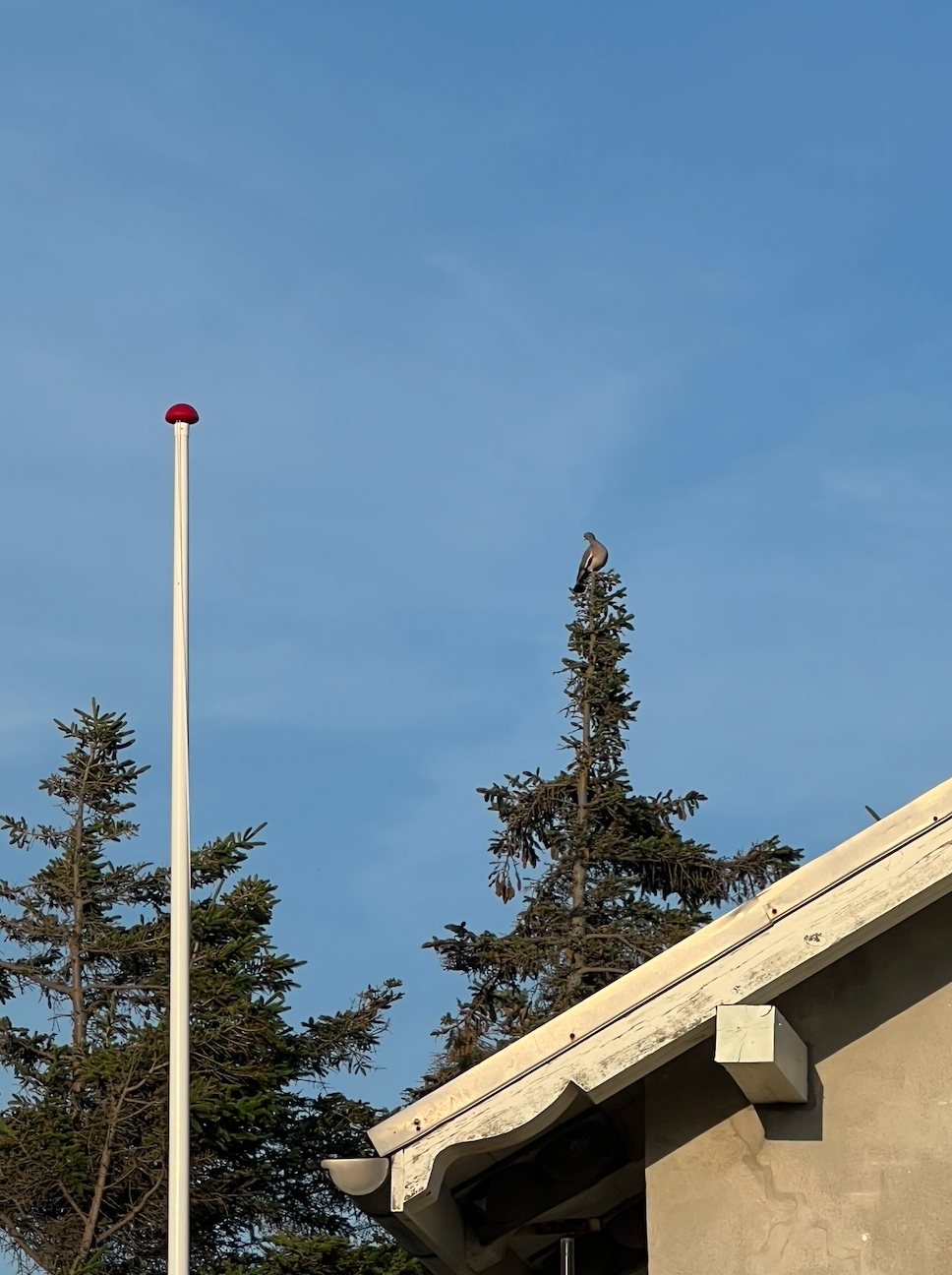
One of the Wood Pigeons in question.
I had a wonderful last full day here at the station, and I will miss the lively company and the (not so many) birds. Hopefully, the migration will pick up soon, so that my friends here can be woken up from their birdless slumber and get to work! I am very grateful that I got to spend some time here at Blåvand Fuglestation and will definitely come back to visit in the near future. Thanks for an amazing experience!
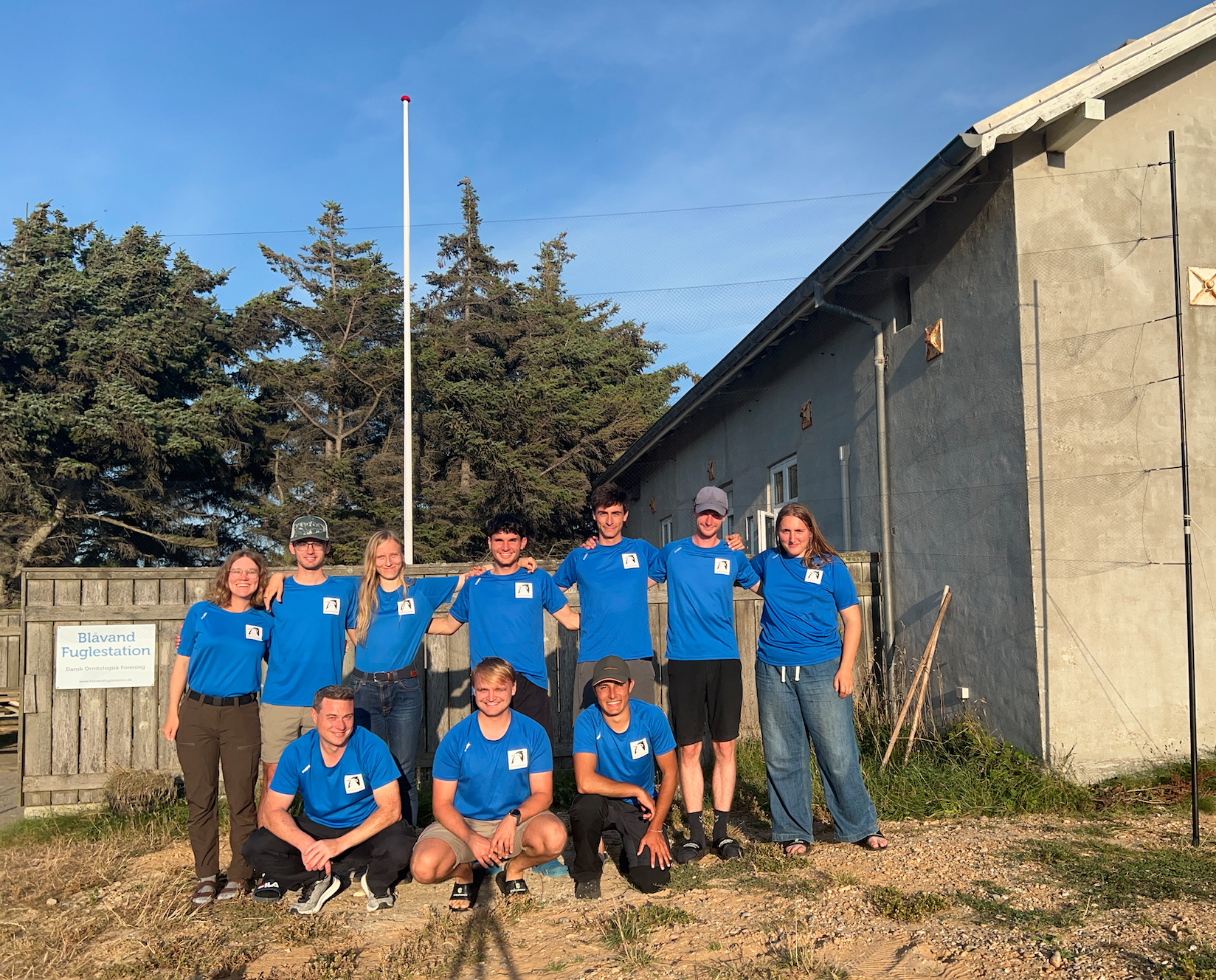
After dinner, we finally got around to taking the group photo that we've been wanting to take for about a month.
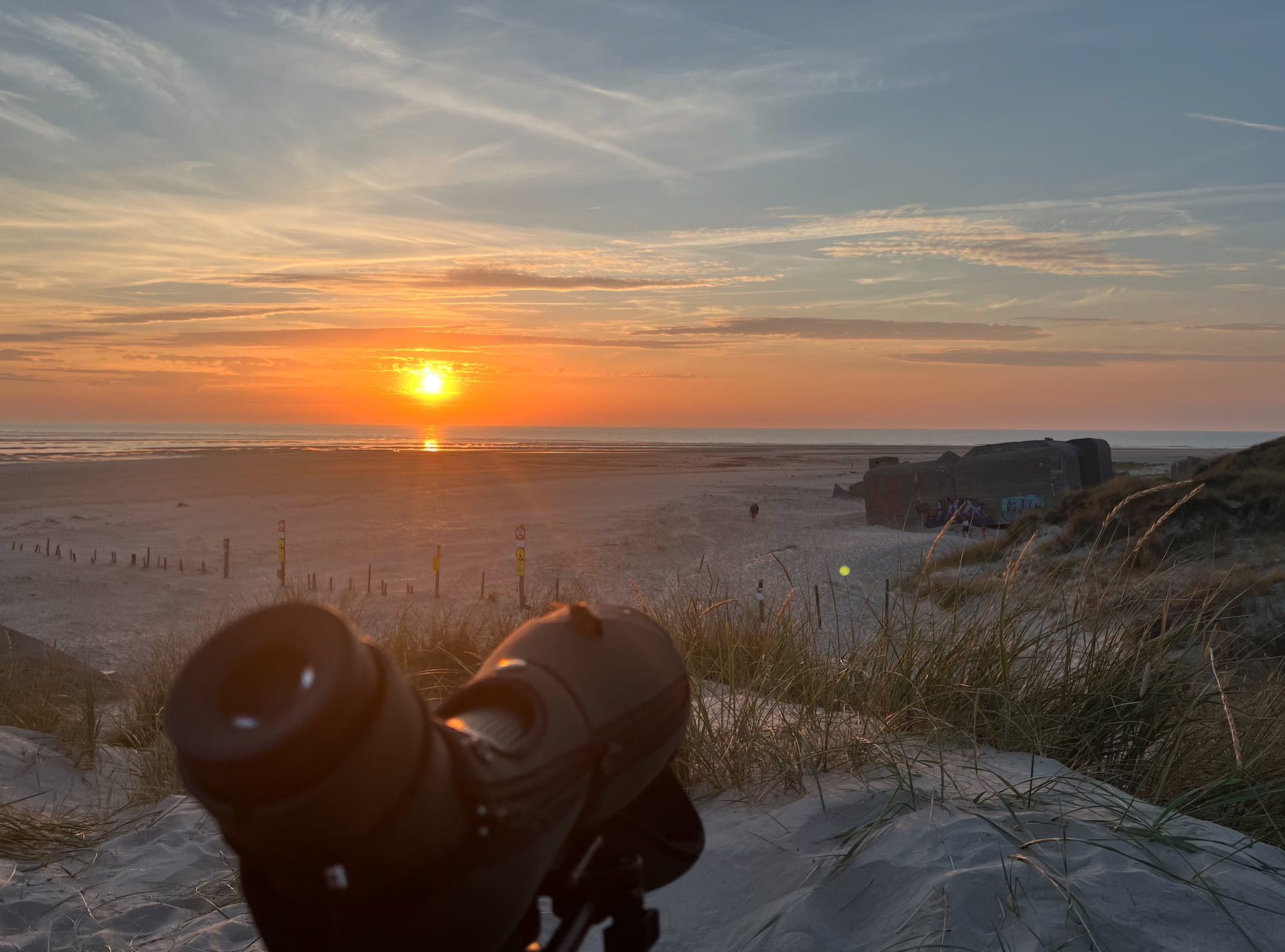
A beautiful last sunset at the counting spot.
Today's totals:
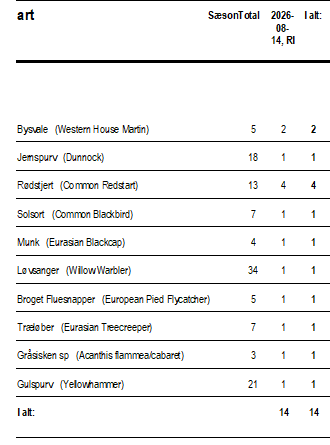
At the station: David, Miguel, Lois, Nico, Alba, Strummer, Johan, Ida, Henrik, Jonas, and Stig Nielsen
Quiet August Day
torsdag 13. august 2026
Ringing
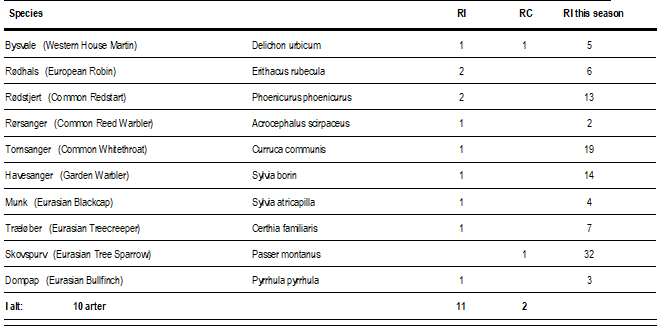
Today was another slow day of ringing at Blaavand. Thankfully, unlike many of the previous days we were able to reach ten new birds ringed during standard time. Some highlights included our third Bullfinch (Dompap) of the season and pairs of both Robin and Redstart (Rødhals and Rødstjert) which were all welcome suprises. Most shockingly, we caught our second Reed Warbler (Rørsanger) of the season, a bird that we dilligently confirmed with measurements.
After standard time, we made sure to spend some effort trying to catch House Martin (Bysvale) which yeilded on new bird and one recapture. Hopefully the future days will bring us more luck but these slow days have given us time to analyze each bird we catch.
Black-tailed Godwits!
torsdag 13. august 2026
Migration today was quite slow in these completely calm conditions, but a nice surprise in the late evening saved the day. Just a few minutes after Jonas mentioned the possibility of Black-tailed godwits at this time of year, a group of 4 distant Godwits migrating southwards was spotted. As they approached the headland, the ID was clear: we got them!
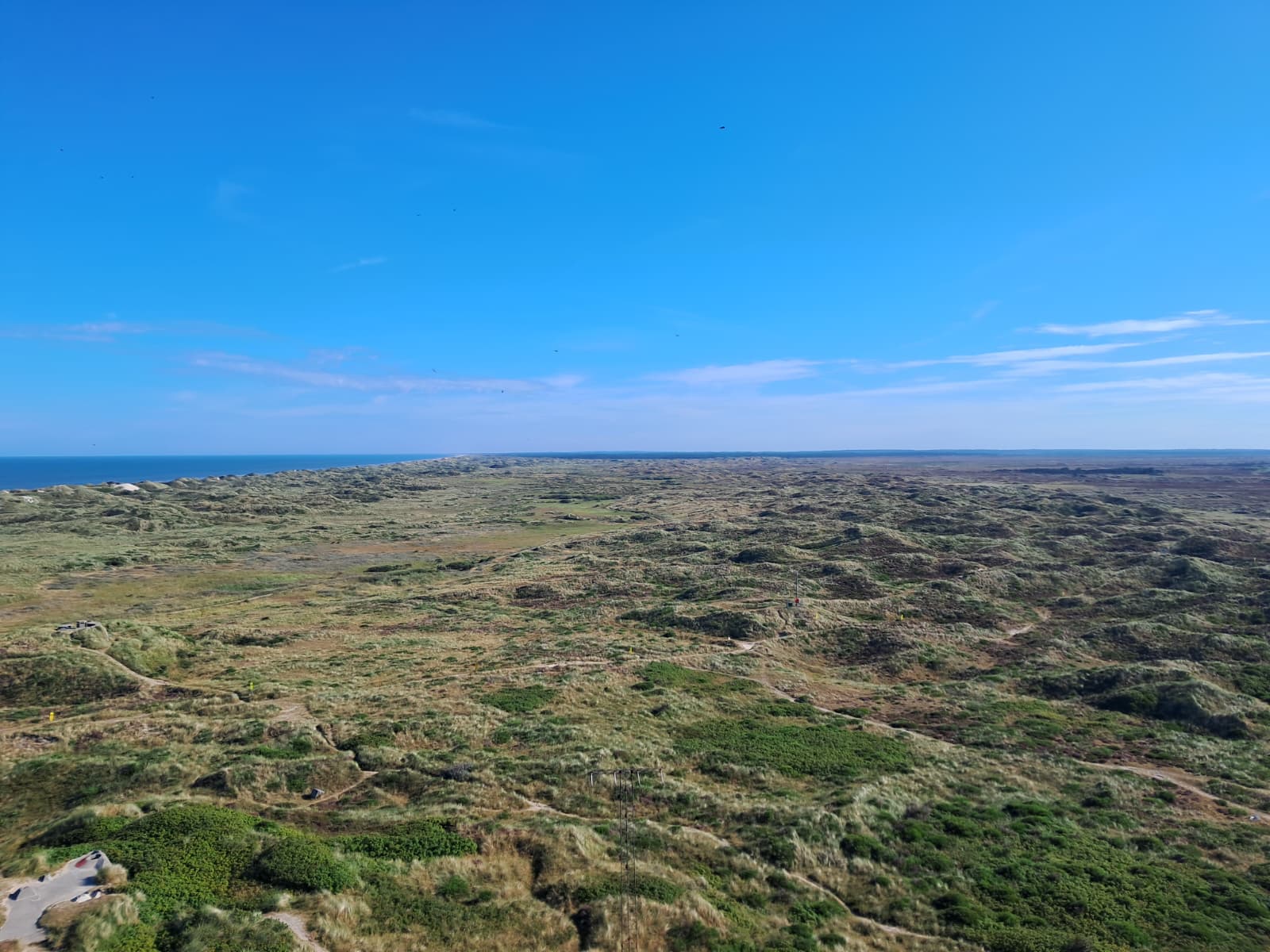
Blaavand dunes from the Lighthouse top